The Lepidoptera Log - by Steve Woodhall
How to keep a record of your local butterflies
Take photos, get them identified, then start counting!
Nowadays people are placing increasing value on their natural surroundings and how they provide multiple benefits in the form of health, sustainable living, and well-being in general. Wildlife holidays are becoming more popular all the time. However, we are beginning to realize that we don’t have to venture further than our backyards to appreciate nature. We grow indigenous plants in our gardens. We support our local conservancies to develop parks, roadsides, and riversides to act as refuges and corridors for wildlife. This is particularly so in my home city of Durban where organisations like Kloof Conservancy are working hard to support municipal efforts to protect and promote biodiversity, like the D’MOSS (Durban Municipal Open Spaces System).
Birdwatching has become enormously popular in recent years. A community of guides, bird clubs, and equipment vendors to supply aids like cameras and binoculars has developed.
Birds are a great way to see how successful attempts to reinvigorate local biodiversity have been. They are what is called an ‘indicator group’; a healthy bird population is a good sign that the local ecosystems are in good health. But of course, birds are not the only indicators of healthy ecosystems and biodiversity. In ecological terms they are mostly primary or secondary consumers of the primary producers of biodiversity – plants. They have the advantage of being attractive and conspicuous, which makes them effective indicators. There is another group of organisms that are popular with the public and are good indicators of ecological health – butterflies. They are smaller than birds and present challenges to those who would study them. But…
Photographing butterflies and getting them identified is easier than ever. A computer and a modern smartphone are usually enough; you do not need an expensive mirrorless or DSLR camera, although one can help with close-up shots.
A guidebook such as the Field Guide to Butterflies of South Africa, or an app such as Woodhall’s Butterflies of South Africa, can help you identify the species and understand where it fits within the butterfly families. These resources should help you make a reasonable identification, but it is useful to have a way to confirm it. iNaturalist is one of the best platforms for confirming butterfly identifications.
iNaturalist has great information on how to register and upload your photos. It makes identification quicker if you have a reasonable idea of what you saw, because it has a great community of identifiers who will find your pictures more easily if you tagged them with an identification. You can also tag me, @stevewoodhall, and I will get a notification that you need some help or a confirmation of an identification.
iNaturalist has over the years built a massive database of all living things on Earth, South Africa included. At the time of writing this (late June 2026) South Africa had over 7 million records of which over 150 000 are butterflies.

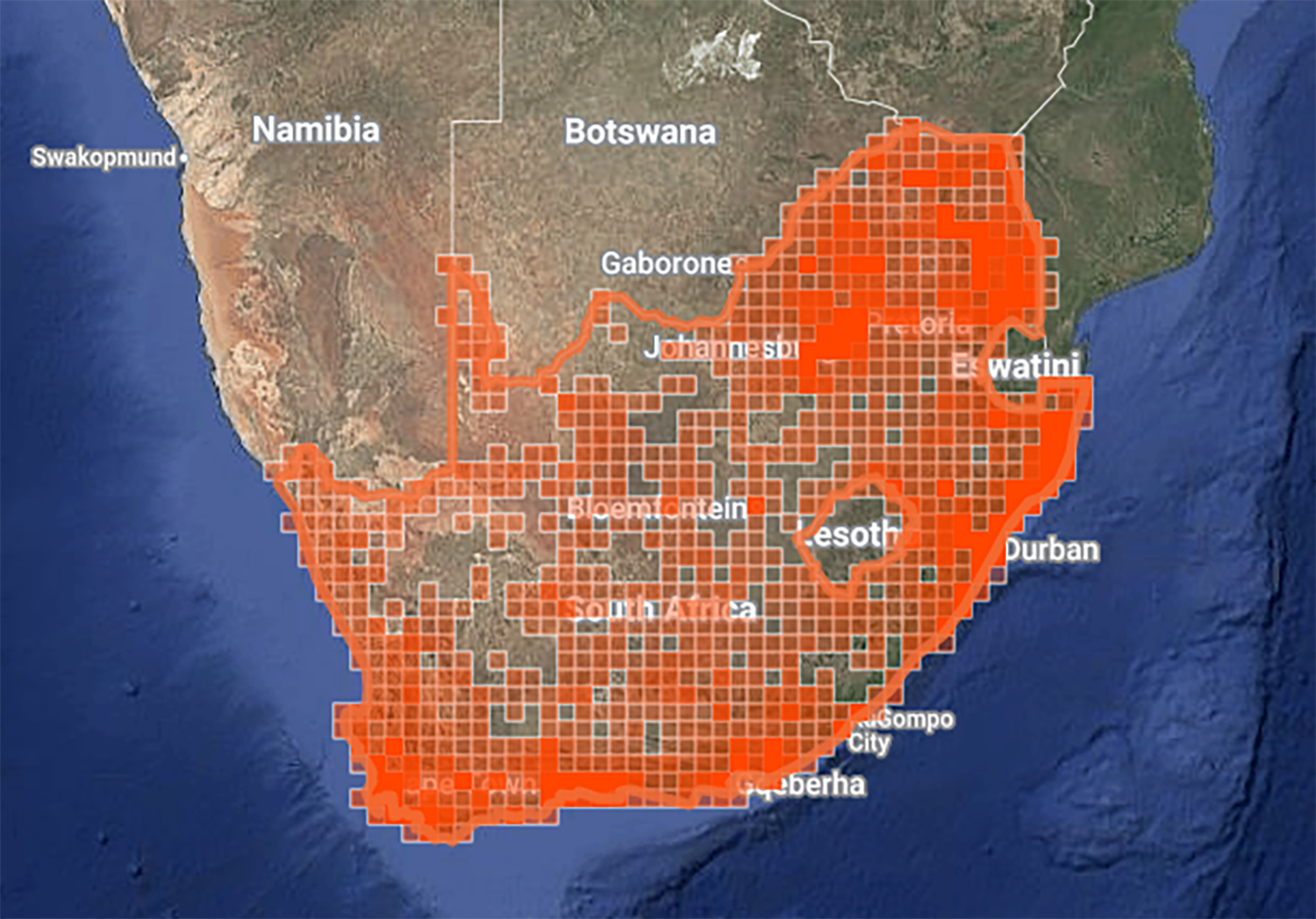
iNaturalist map of all butterfly records in South Africa
This map, taken off the iNaturalist site, shows all the grid squares that have butterfly records. The deeper the red colour the more records there are per square. It’s very easy to upload a record to iNaturalist. It will look like this one, which I uploaded recently:

An example of a record uploaded to iNaturalist
‘Research Grade’ means that the photograph’s identification has been confirmed by one of the community of identifiers. Anyone with a free iNaturalist account can be an identifier. You don’t need a formal qualification or to sit an examination, although iNaturalist regularly runs quality control checks.
iNaturalist relies on a collaborative, community-driven approach where you simply suggest identifications based on your own knowledge and the evidence provided. The site does however give some advice on how to conduct yourself as an identifier.
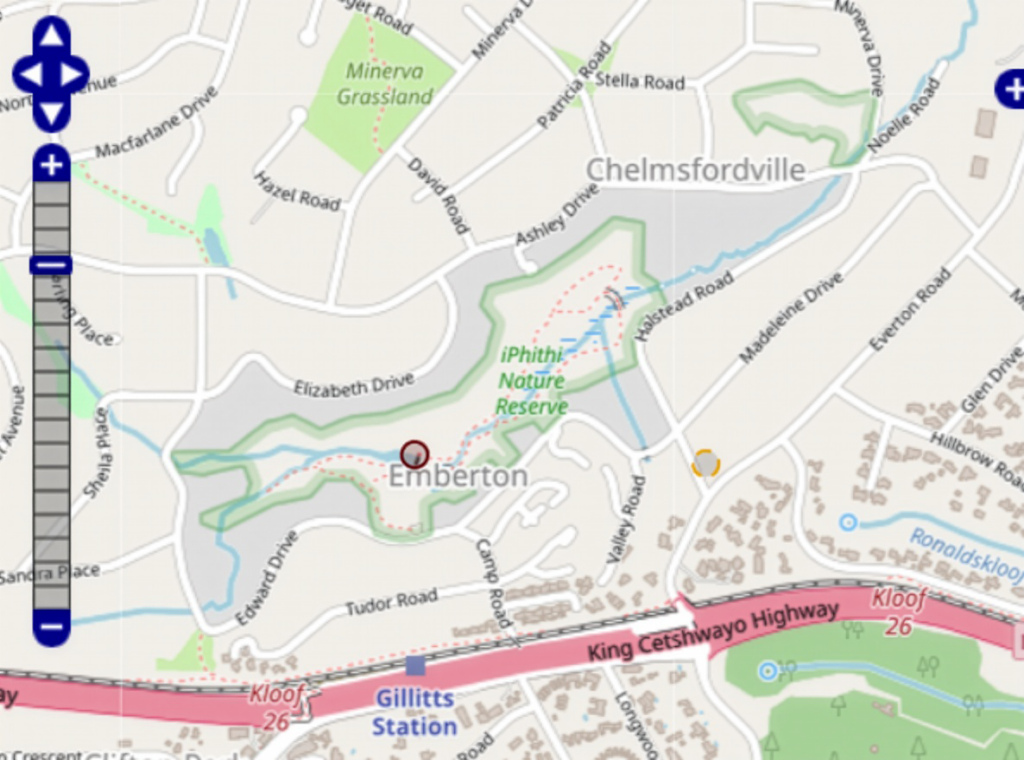
That record, shown by a big red pin in the middle of the map, came from iPhithi Nature Reserve, a small (12 hectare) area of rewilded land inside my suburb of Chelmsfordville.

iPhithi Nature Reserve's iNaturalist Place map
Uploading data is not the only thing you can do with iNaturalist. You can use those data to extract information. There are many ways to do this; to cover them all would need a whole website to itself! The simplest way is to use iNaturalist’s own search tools, described here. You could also export the data to a comma separated value (csv) file that can be analysed using Microsoft Excel or other proprietary data analysis tools like Python or R. This can be done by creating a query.
I exported the data for iPhithi nature reserve using the query tool and then analysed it in Microsoft Excel using Copilot. As an example of what can be done, here is a plot showing the butterfly species most often seen during the 12 years iNaturalist has been used in iPhithi:

iPhithi Nature Reserve's iNaturalist Top 20 butterfly records
On the face of it, this looks like a great way to find out what are the commonest butterflies in the reserve. The Yellow-banded Pansy Junonia elgiva shown above is at number 3 on the list. Above it are the Bush Bronze Cacyreus lingeus and Water Watchman Parnara monasi. Are these really the commonest butterflies in the reserve, or just the ones that got photographed the most times because they stand out more? These photos were both taken in the reserve and had their identity confirmed using iNaturalist.

Water Watchman ♂
Parnara monasi

Bush Bronze ♂
Cacyreus lingeus
iNaturalist is good for recording occurrence data for a site – a photo of a single butterfly with a GPS reference is evidence that it occurs there. It’s also good for confirming identifications via peer review from the identifier community. It can give an idea of what the most commonly seen species are, and it’s great for recording rarities. It can give you a crude measure of how numbers vary over time.
What it’s not so good at is accurately counting numbers over time. Each photo is a single record. If you were to use it to count every Bush Bronze in the reserve during your visit, you might need to take and upload dozens of photos!
You may want to make conservation decisions from an accurate idea of what the commonest butterflies are at a site, or find out how their numbers vary over time, and if are there any absences (iNaturalist is good at showing what IS present, but not what ISN’T). This is vital if you want to use butterflies to measure the health of your ecosystem. Are the numbers growing, shrinking, or stable? To do this you’d need to gather scientifically valid abundance data. This is where the Butterfly Monitoring Scheme comes in.
The European Butterfly Monitoring Scheme (eBMS) has recently been expanded to cover all of Africa. Species lists have been uploaded for South Africa among other countries. The scheme allows to methods of butterfly counting. One is the ‘Pollard Walk Transect Count’ The other is the ’15-minute timed count’ which can be carried out anywhere.
These methods are described here: https://butterfly-monitoring.net/bms-methods
All you need to do is go to the site, create an account, choose the ‘South Africa BMS’ scheme and the ‘full taxa list’. Once you have an account and have created a password, go to the https://butterfly-monitoring.net/ebms-app page and follow the instructions to download the app to your phone.
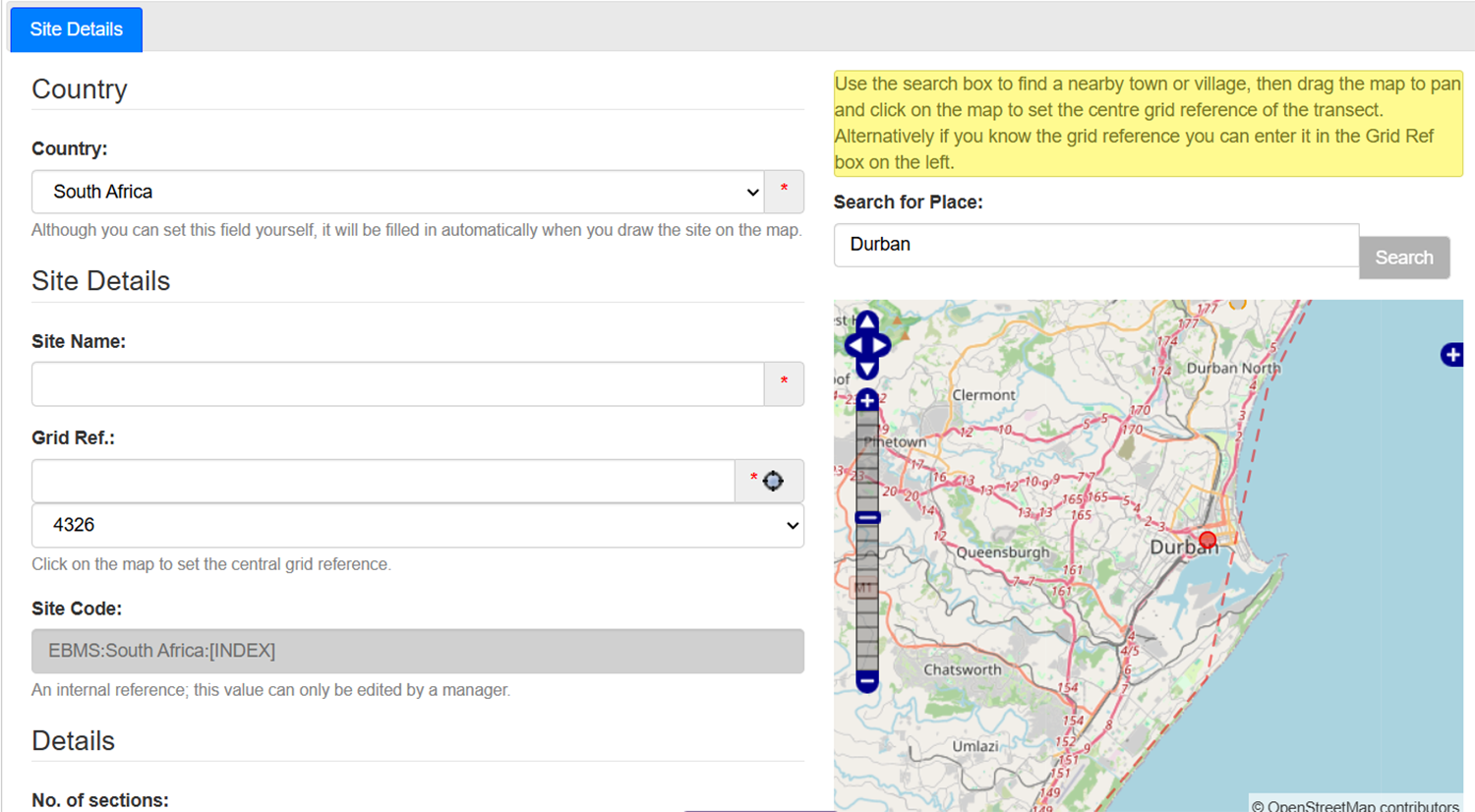
Once you are registered you can set up a transect walk, by going to https://butterfly-monitoring.net/ebms-site-details. The screenshot below shows how to start:
Choose a name for your site and use the map to zoom into your chosen route. This is the site for iPhithi Nature Reserve:
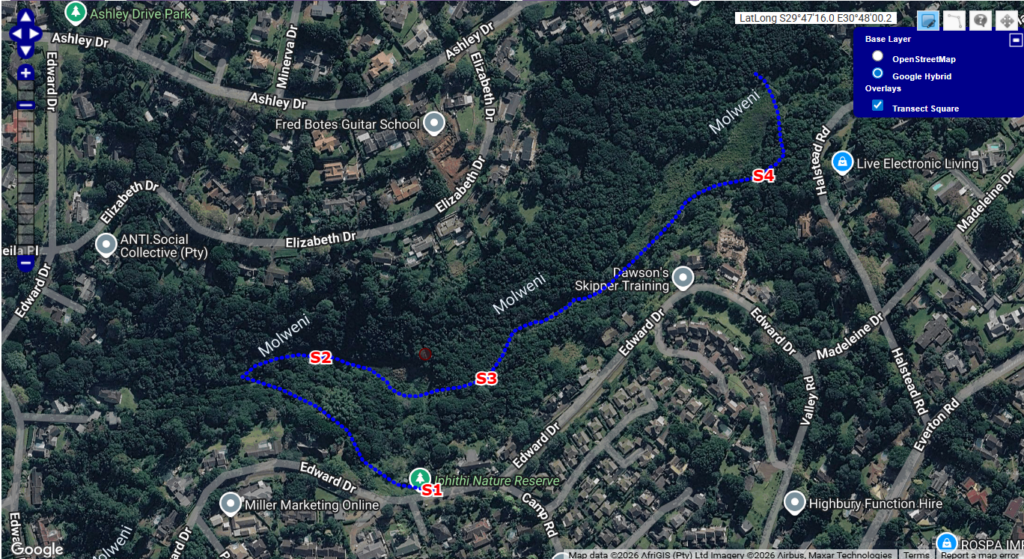
When you visualise the transect during the registration process on the site you can see exactly where the transect and its sections are on the map.
These are the four sections I set up along the Pollard Walk in iPhithi Nature Reserve. The first (S1) is in a fairly open hillside grassland-woodland mosaic along the path from the entrance to the ‘boma’ at the start of the streamside path. S2 follows the stream to the dam in the middle of the reserve and skirts its edge. S3 is in heavy riverine forest along the stream below the dam, with areas of recovered grassland. S4 crosses the major wetland at the northeastern end of the reserve.
You’ll probably notice that the walk follows the same route where >90% of the iNaturalist observations were made. This is no accident – I regularly take photos along the route.
Below are some photos taken along the transect.

Entrance to iPhithi Nature Reserve
This is where Section 1 starts

Grassland at the top of iPhithi
Just after the start of Section 1

Between the boma and the dam
Along Section 2

iPhithi dam
Along Section 2

Riverine vegetation along the iPhithi stream
Along Section 3

The boardwalk over the big wetland in iPhithi
Section 4 crosses this
Let’s look at some of the butterflies we’ve seen along that transect. We can only cover a few of the 130 confirmed species we’ve seen there.

Yellow-banded Pansy ♂
Junonia elgiva
Yellow-banded Pansy is one of the commonest brightly coloured butterflies seen in iPhithi, with 142 sightings along the transect to date. They love to flit around the thick vegetation along sections 2 and 3, resting low down with wings held open. Like most Pansies its caterpillars feed on plants in the Acanthaceae, like Justicia and Dyschoriste.

Dead-leaf Commodore ♀
Precis tugela tugela
Dead-leaf Commodore is fairly rare in the reserve, with only four counted since we started doing the transects. It’s a butterfly more suited to the Afromontane forests further inland rather than the Scarp Forest at iPhithi. It’s usually seen along section 1. Its caterpillars feed on Lamiaceae, like Coleus. The line of dark spots inside the orange (rather than yellow) bands distinguish it from the Yellow-banded Pansy.

Variable Bush Brown ♂
Bicyclus safitza safitza
Variable Bush Brown (until recently the Black-haired Bush Brown) is absolutely the commonest butterfly in iPhithi, with 385 sightings along the transect to date. They fly low down in the thick vegetation along sections 1, 2, and 3, often in groups of two or more, settling with closed wings like this male. The caterpillars feed on low-growing grasses like Basket-grass Oplismenus hirtellus, which loves shade.

Common Evening Brown ♂
Melanitis leda
Common Evening Brown is fairly rare in the reserve, with 12 counted since we started doing the transects. It’s a skulker of note, preferring shady spots where it hides during the day, emerging at dusk to fly. It’s probably undercounted because they are normally only seen when disturbed, Their undersides are exquisitely camouflaged. They are most often seen in the riverine vegetation along sections 2 and 3.

Common Mother-of-Pearl ♂
Protogoniomorpha parhassus
Common Mother-of-Pearl is iPhithi’s most often seen ‘big flashy’ butterfly with 134 sightings to date. Its caterpillars use a common shade-loving perennial, Sticky Acanth Phaulopsis imbricata. They are often seen in sunny clearings along the stream and at the dam, engaging in territorial battles. They are most often seen in late summer and autumn.

White Pearl Charaxes ♂
Charaxes varanes varanes
White Pearl Charaxes is another ‘big flashy’ that keeps mostly to the forest canopy and is only seen along section 1 or where the edges of the canopy are close to the path. It’s extremely conspicuous as it flies over the dark green foliage. Its caterpillars feed on Dune false-currant Allophylus natalensis.

Narrow Green-Banded Swallowtail ♂
Papilio nireus lyaeus
Southern Narrow Green-Banded Swallowtail (now Southern Narrow-banded Malachite) is often seen on iPhithi’s muddy places in sections 1 and 4. Its caterpillars feed on wild members of the Citrus family, Rutaceae, like White-ironwood Vepris lanceolata.

Linear Southern Emperor Swallowtail ♀
Papilio ophidicephalus phalusco
Linear Southern Emperor Swallowtail is South Africa’s biggest butterfly, that occasionally shows up flying up and down the valley. There are five records in the reserve. It’s most often seen in the Afromontane forests further inland but clearly there’s a small population in Chelmsfordville. It hasn’t yet been photographed inside iPhithi.

Bush Bronze ♂
Cacyreus lingeus
Bush Bronze is iPhithi’s commonest tiny butterfly with 248 sightings to date. Its caterpillars feed on many species of Lamiaceae like Salvia, Coleus, and Mentha species, that favour moist and boggy places like the streamside and wetlands.

White-tipped Ash Blue ♀ R ♂ L
Eicochrysops hippocrates
White-tipped Ash Blue is another common butterfly in iPhithi (118 sightings) where its caterpillars feed on an aquatic plant, Slender Knotweed Persicaria decipiens. It is found along sections 2 and 4 flying low along the water’s edge.

Dwindling Barred Sailer ♂
Neptis laeta
Common (now Dwindling) Barred Sailer is a butterfly sometimes seen floating slowly around iPhithi’s clearings, especially over water. There have been 57 sightings. Its caterpillars feed on several local species of tree; Flat-crown Albizia adianthifolia is one, another is Climbing flat-bean, Dalbergia obovata.

Lowland Bush Beauty ♂
Paralethe dendrophilus indosa
Lowland Bush Beauty is a beautiful large butterfly that’s totally endemic to South Africa’s eastern forests. In iPhithi we see it from March to May only, peaking in April. Its nocturnal caterpillars feed on forest grasses like Broad-leafed Bristle-grass Setaria megaphylla.

iPhithi Nature Reserve's eBMS top 20 butterflies seen on Pollard Walks
This tells a very different story to the iNaturalist data! Variable Bush Brown Bicyclus safitza was number 5 on the iNaturalist chart, but when counted using the eBMS Pollard Walk methodology it was number 1 by a long way. Bush Bronze Cacyreus lingeus was knocked off its perch but is still near the top spot. The African Migrant Catopsilia florella was often seen migrating during the Pollard Walks but is seldom photographed because it never sits still for long enough. African Grass Blue Zizeeria knysna knysna was way down the chart on iNaturalist but was number 5 on the Pollard Walk counts.

African Migrant ♂
Catopsilia florella
African Migrants are often seen flying across the Pollard Walk line during migrations, resulting in a count of 225. They are very hard to photograph, usually only settling in the grass when a strong wind is blowing, like this one did. There are only 11 photo records in iNaturalist.

African Grass Blue ♂
Zizeeria knysna knysna
African Grass Blue is very common in iPhithi especially in the grassy areas in section 1. It isn’t often photographed because that involves bending down or getting grass-stained knees! They are quite easy to count using close focusing binoculars to separate them from the very similar African Clover Blue which is much rarer with only 3 records.

iPhithi Nature Reserve's eBMS Pollard Walk counts averaged over a typical year
This chart was extracted from the eBMS database as a comma separated value (csv) file and analysed using Microsoft 365’s Copilot AI. Averaged over almost three years, it shows a clear seasonal bimodal peak in May and August, dropping off drastically at the onset of cool weather in September.

iPhithi Nature Reserve's eBMS Pollard Walk trends over 33 months
This chart uses the same data to exhibit seasonal and annual trends for individuals and taxa (species). The trends show up clearly using a 12 month moving average plot on individual monthly averages. 2025 was clearly a better year than 2024 but 2026 looks like being poor. The trends for numbers of species seen seems to mirror the individuals counts.
This was the pilot scheme for South Africa. It took a lot of effort to get those 111 counts done. I had a lot of help from fellow local lepidopterists Richard McKibbin and Brad Hean and, importantly, Dr David Roy at the UK Centre for Ecology & Hydrology. The challenge now is to get more plots like this done in every town and province in South Africa. When we have a true long term time series we can correct for climatic variables like rainfall, cloud cover, and temperature. That will allow us to track the health of our butterfly populations in the same way the British have been doing tor 50-odd years, and the Europeans for almost as long.
Here are the details of the 15-minute timed counts I’ve been doing in my garden. Those also offer a great opportunity for the public to gather butterfly data at scale. This will empower them to influence conservation policy the way the BMS has done in Europe. Please read this post and I hope it encourages you to have a go yourself. If you need any help just drop me a mail to steve@butterflygear.co.za. The best time to start doing this was in 1976. The second best time is now.