Skip to content

The Lepidoptera Log - by Steve Woodhall

Making sense of the 'Tips' - part two

More confusing white butterflies with variously coloured wing tips!

In part one I covered the butterflies in the Pieridae that have orange (or red) forewing tips. I alluded to some species whose forewing tips are purple or pied black-and-white

To recap, ‘Tips’ belong to the tribe Teracolini in the Pierinae subfamily of Pieridae (Whites and Yellows). They are not related to the UK ‘Orange Tip’ in the genus Anthocharis. Although they can look similar, important differences separate them. Their larvae usually feed on plants in the caper family, Capparaceae, rather than Brassicaceae.

In general, they are pale butterflies with coloured or patterned forewing tips. These tips are often dark or contain contrasting cells. Other markings in the paler areas beyond the tips usually provide the clues for identifying the species. Most of them have at least one clue, which we’ll share with you here. 

Most African ‘Tips’ are primarily savanna butterflies, though they may extend into nearby biomes such as desert, karoo, or grassland.

Let’s  look at some of the ‘Purple Tips’.

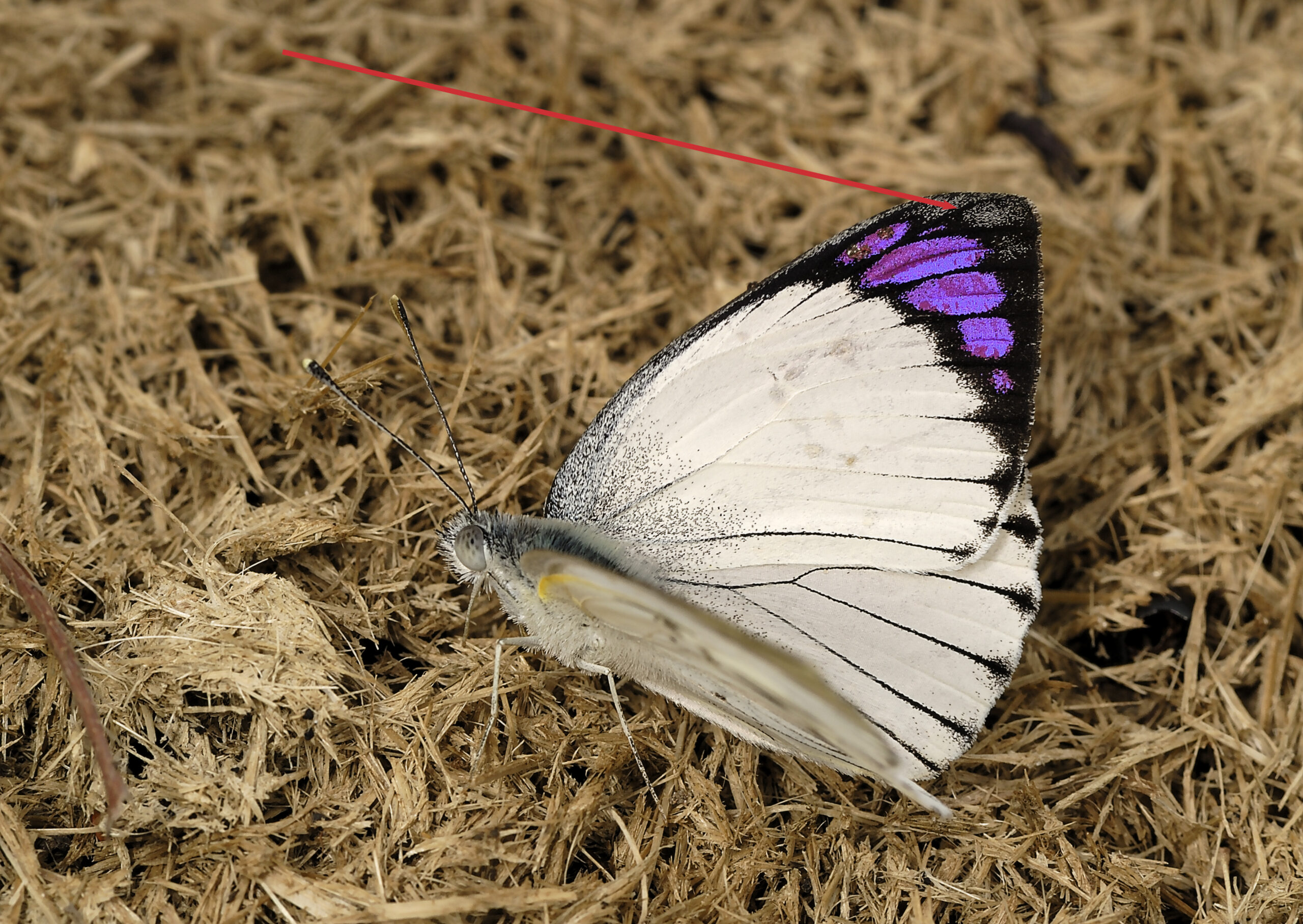
Bushveld Purple Tip, Colotis ione, is a medium sized ‘Tip’ with a male wingspan of 45–50mm and 48–52mm in the female. It’s Africa’s most widespread Purple Tip, inhabiting dry to mesic, frost-free savanna from The Gambia and Senegal in the west, across the Sahel to Sudan and Ethiopia, the drier areas of DRC and Uganda, south to the Eastern Cape in South Africa.

The larval host plants are in the Capparaceae family, including Boscia, Maerua, and Cadaba species.

Bushveld Purple Tip ♂

Colotis ione form phlegyas
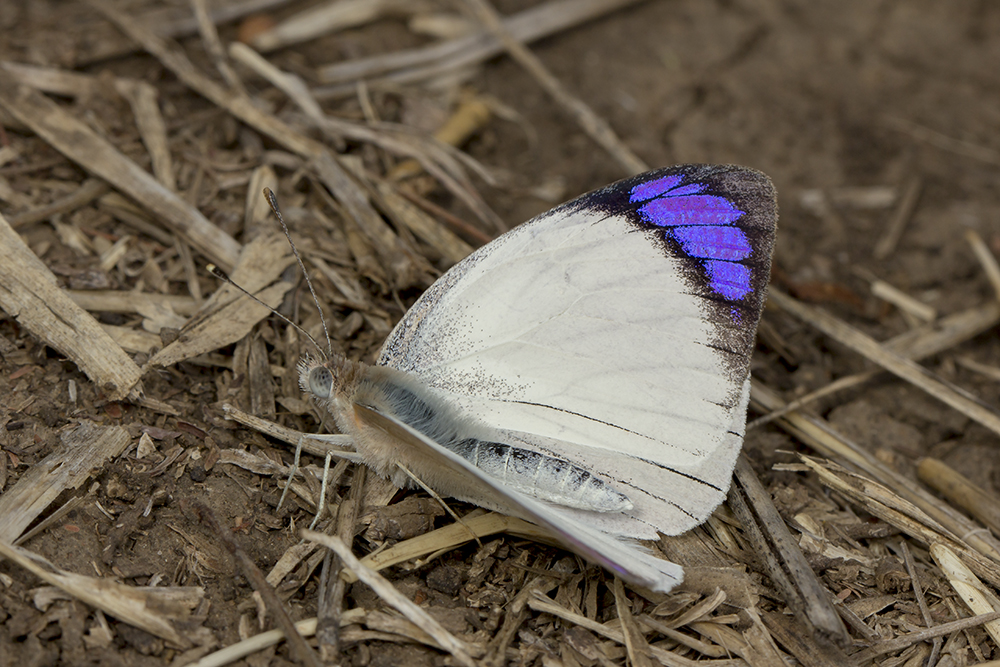
Buahveld Purple Tip ♂

Colotis ione form jalone
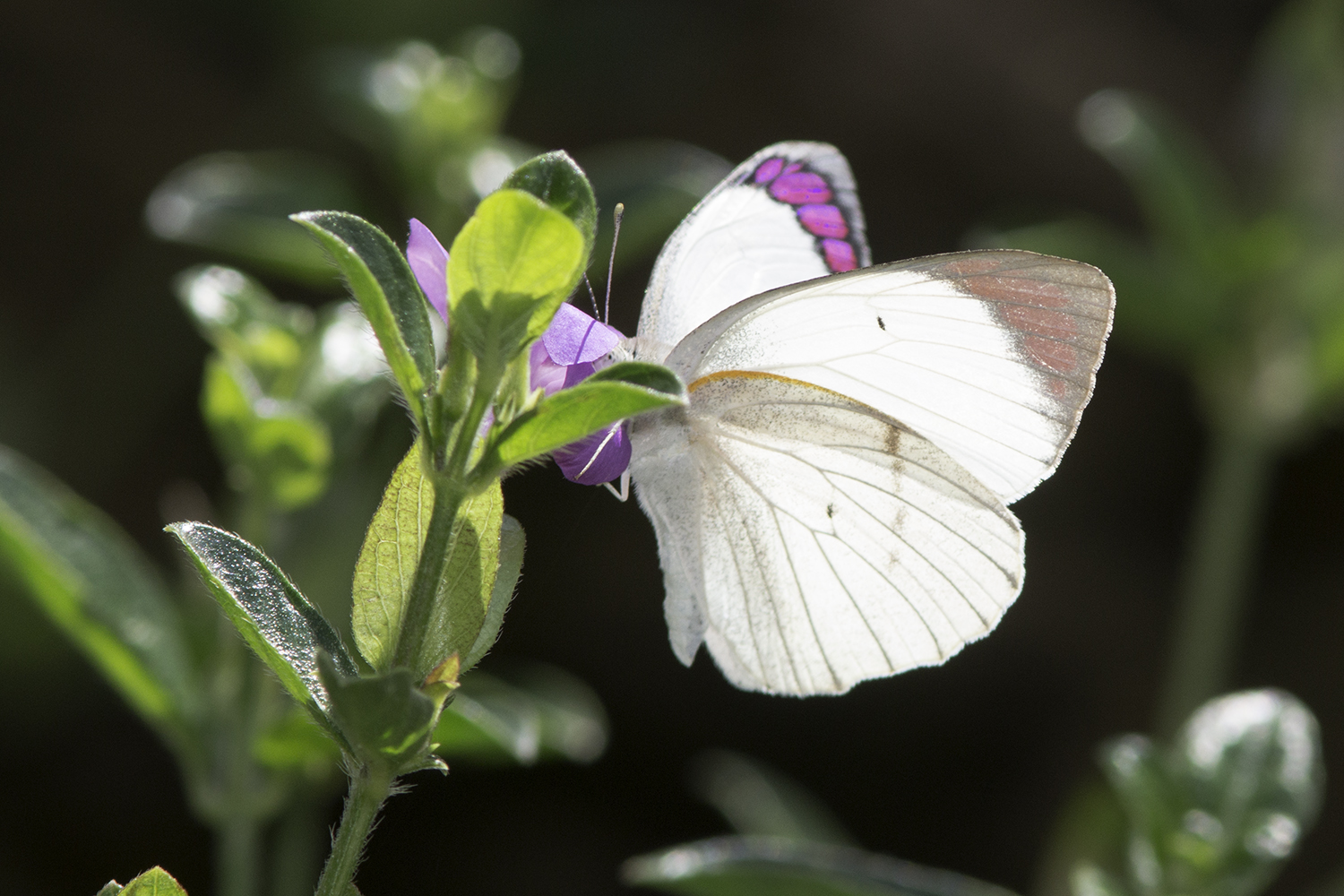
Bushveld Purple Tip ♂

Colotis ione form phlegyas

Bushveld Purple Tip ♂

Colotis ione form jalone
Bushveld Purple Tip ♂

Colotis ione form ione
Males of Colotis ione fly rapidly one to two meters above the ground; females are slower and fly lower,  frequenting thicker vegetation. Both sexes are very fond of flowers. They often settle on the ground and in cool conditions may bask with wings open.

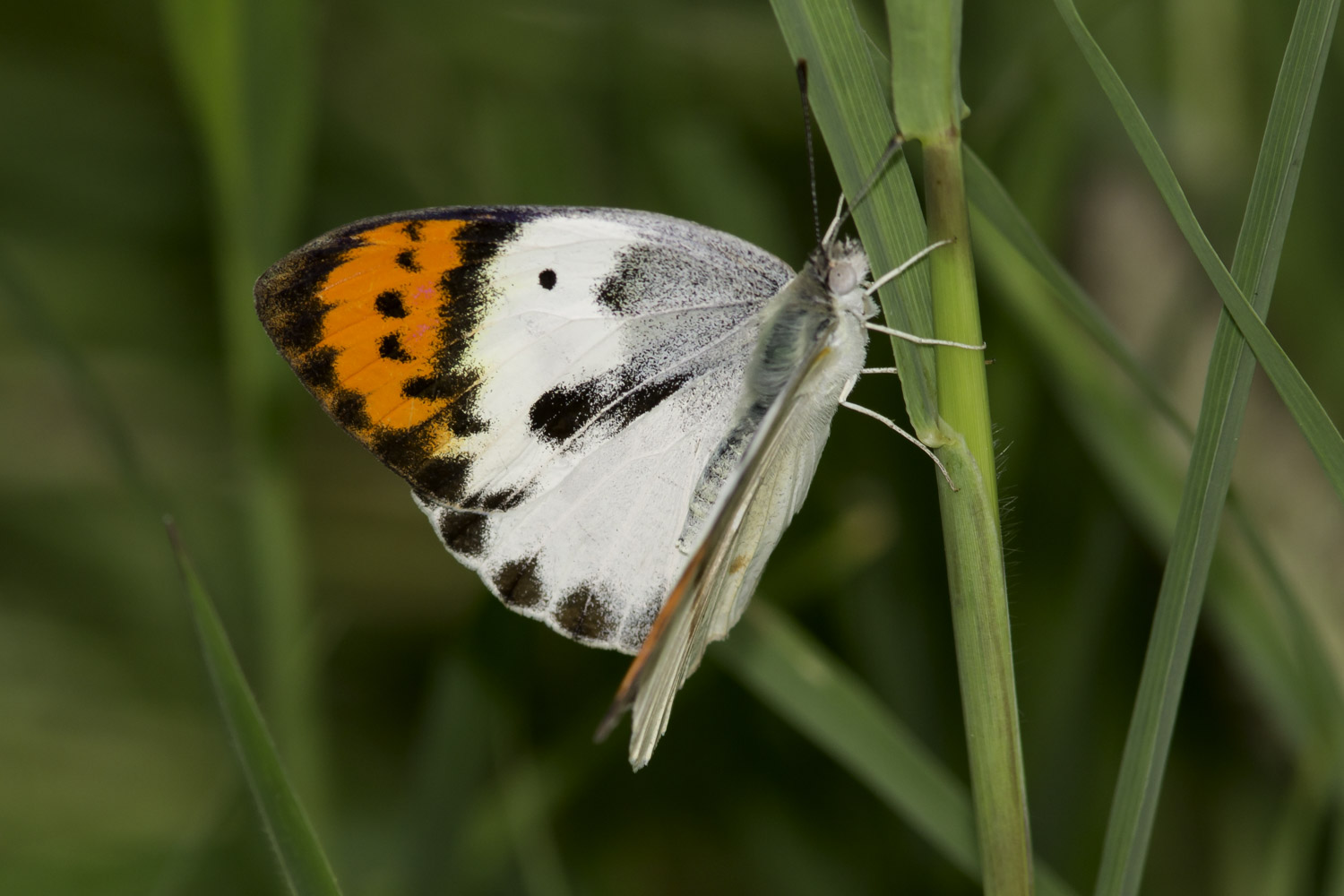
They show strong sexual dimorphism. Males have black forewing tips with four main cells of purple and sometimes a small fifth, with a strong iridescent blue lustre; the wing apex is usually speckled with grey (as arrowed) . The males’ hindwings, and sometimes the basal part of the forewings, may carry a variable degree of black scales along the veins.

Males and all female forms have a range of seasonal forms carrying a decreasing extent of dark markings from wet to dry season forms. In males, the extent to which the wing veins are picked out in black decreases from the wet to the dry season.

Form phlegyas is the wet season form found in the drier northern areas of southern Africa. Form ione is found in the wetter coastal areas and has heavier black wing veining than form phlegyas. Dry season form jalone has less intense dark upper side markings.

Like many Colotis species both sexes’ hindwing and forewing tips’ underside have a pink colour with grey speckling, camouflaging it well among dead winter leaves. 

Bushveld Purple Tip ♀

Colotis ione wet season form ione
Bushveld Purple Tip ♀

Colotis ione wet season form ione
Bushveld Purple Tip ♀

Colotis ione dry season form jalone © Ian & Allison Sharp
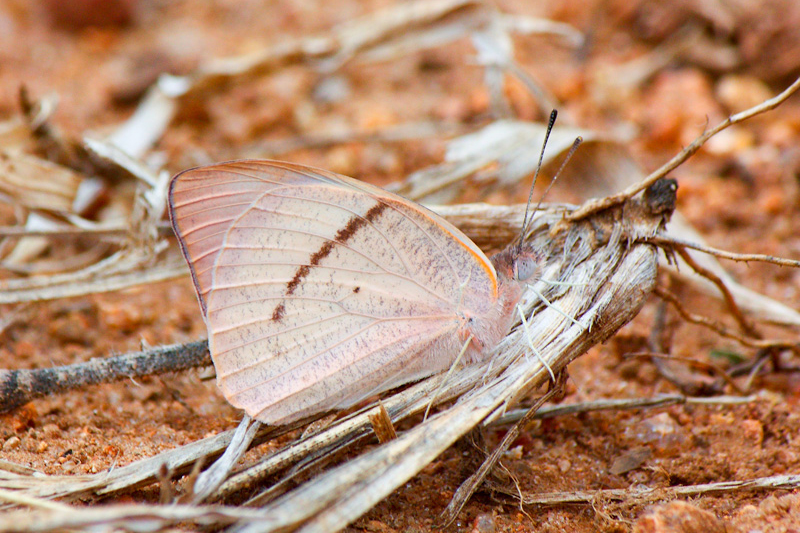
Bushveld Purple Tip ♀

Colotis ione dry season form jalone © Ian & Allison Sharp
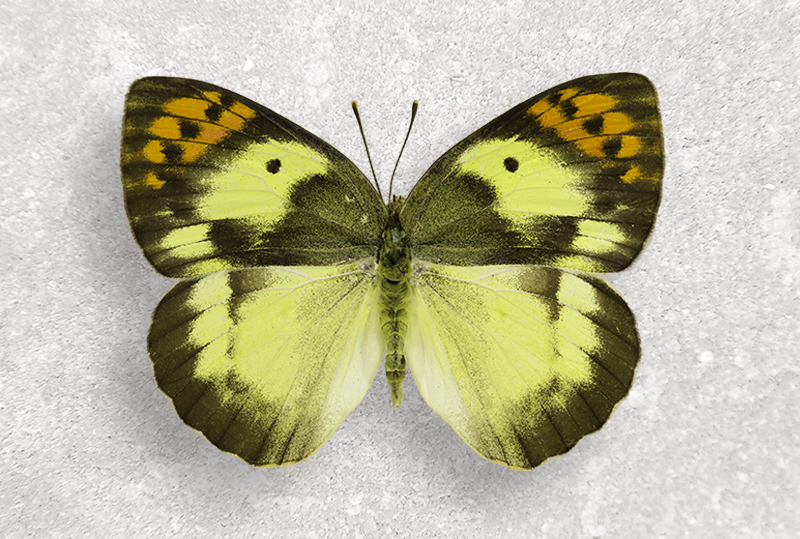
Females are polymorphic. Forms ione, jalone, xanthosana and leda  have orange or red forewing tips bordered and spotted with black or brown. The hue of the orange is less red in dry season forms like jalone and the borders and spots vary in width and how dark a shade of black they are. As in other Colotis species there is a degree of variation between extremes.

Forms woodi, pepita, and xerophila have dark forewing tips containing small white or cream cells.

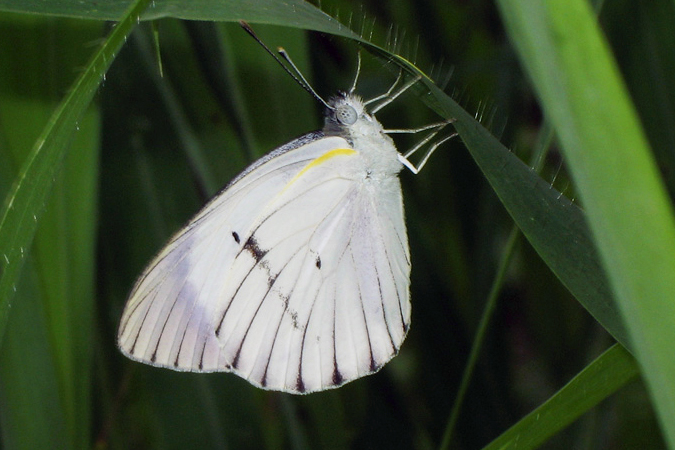
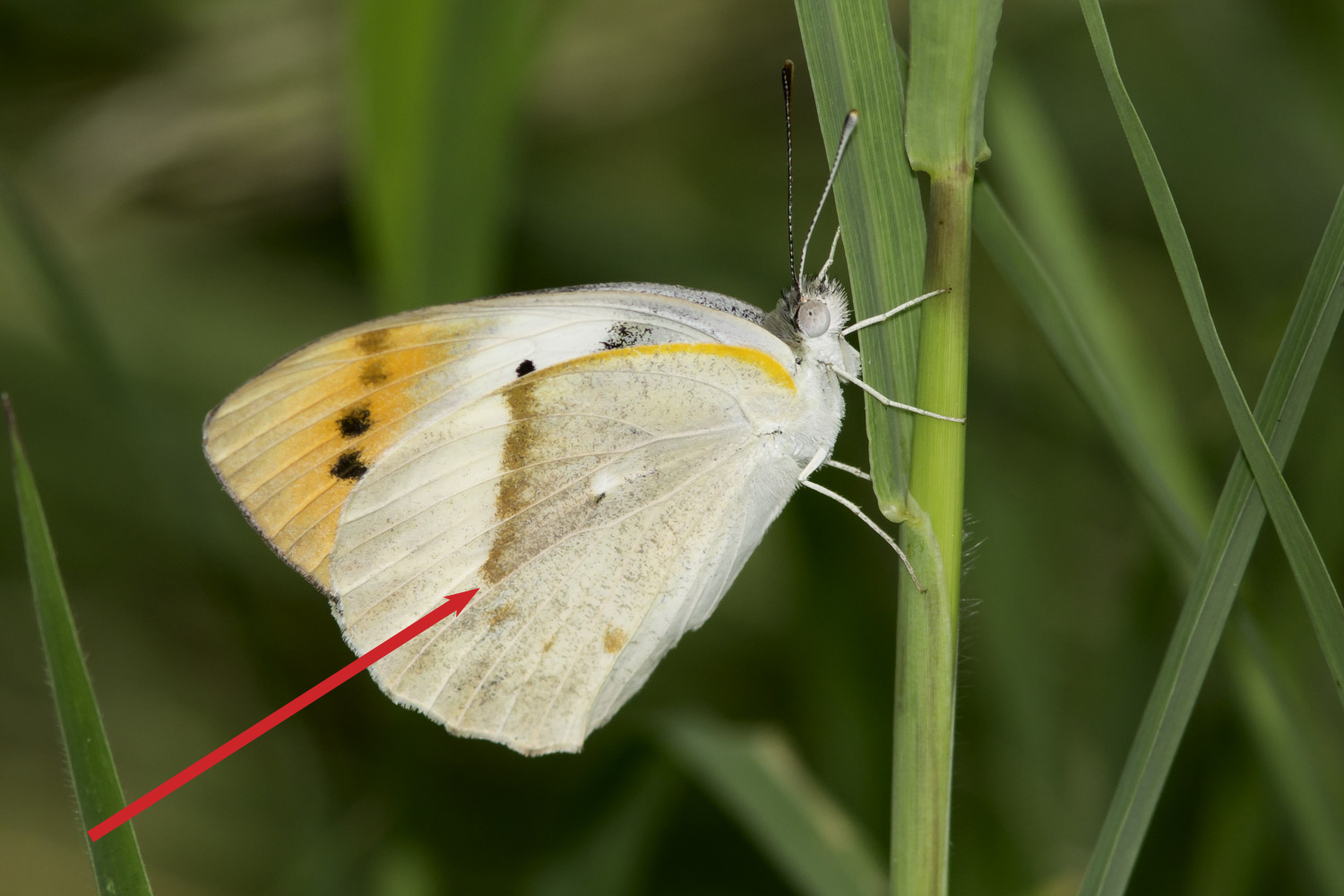
Wet season forms of both sexes usually have white to cream undersides with dark markings following those on the upper side. A diagonal line runs from the costa to vein CuA1, (arrowed) sometimes in females forming an ‘L’ with spots in areas CuA1 and CuA2.

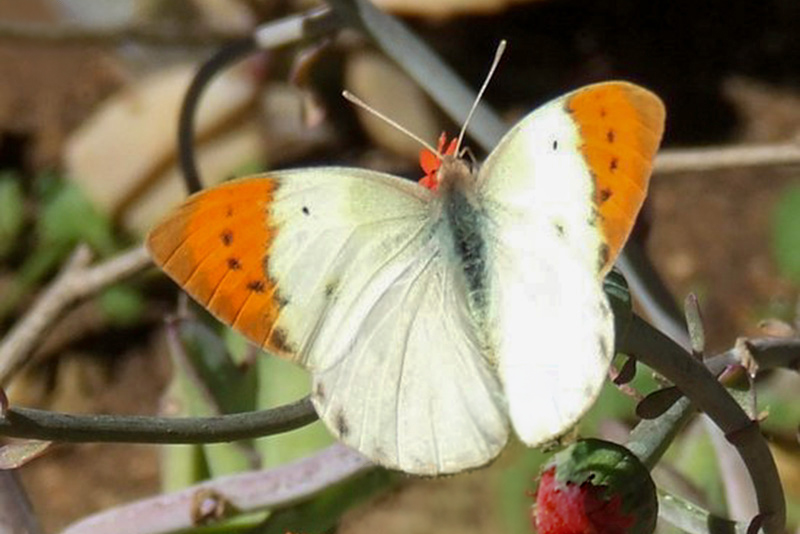
The extreme dry season form erubescens has red-brown forewing tips with a black basal edge (arrowed). Form xanthosana has a yellow, not white, ground colour.

Bushveld Purple Tip ♀

Colotis ione wet season form xanthosana
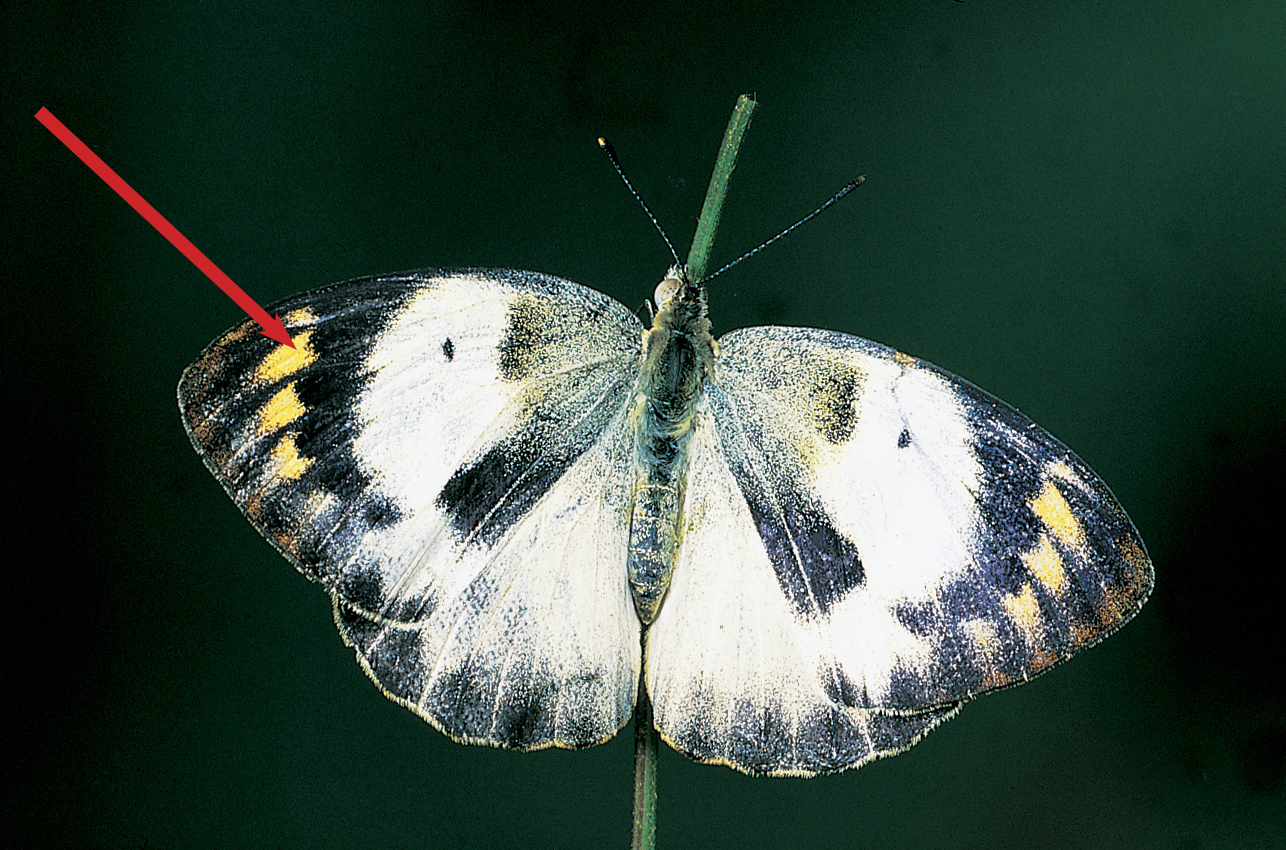
Bushveld Purple Tip ♀

Colotis ione wet season form woodi
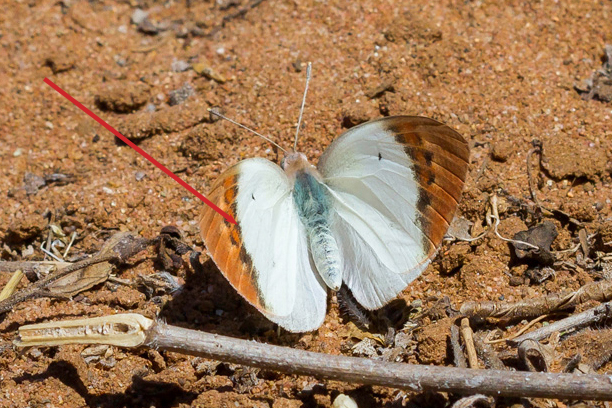
Bushveld Purple Tip ♀

Colotis ione dry season form erubescens © John Wilkinson
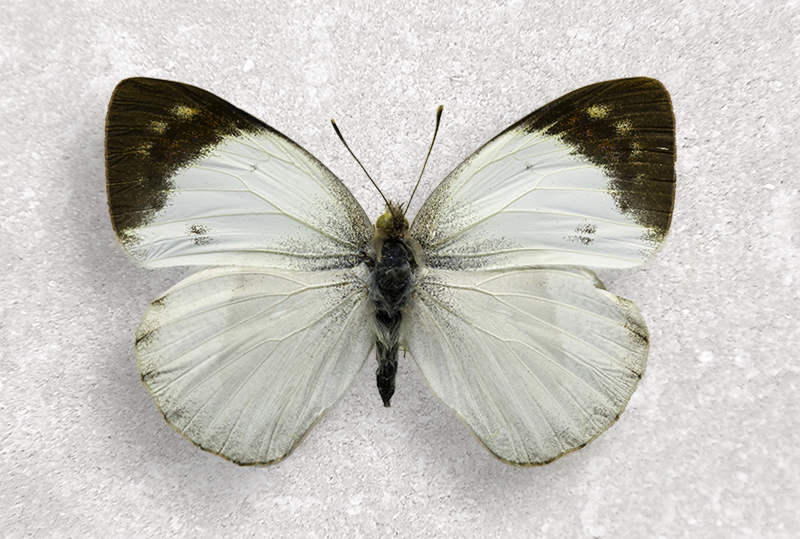
Bushveld Purple Tip ♀

Colotis ione dry season form xerophila
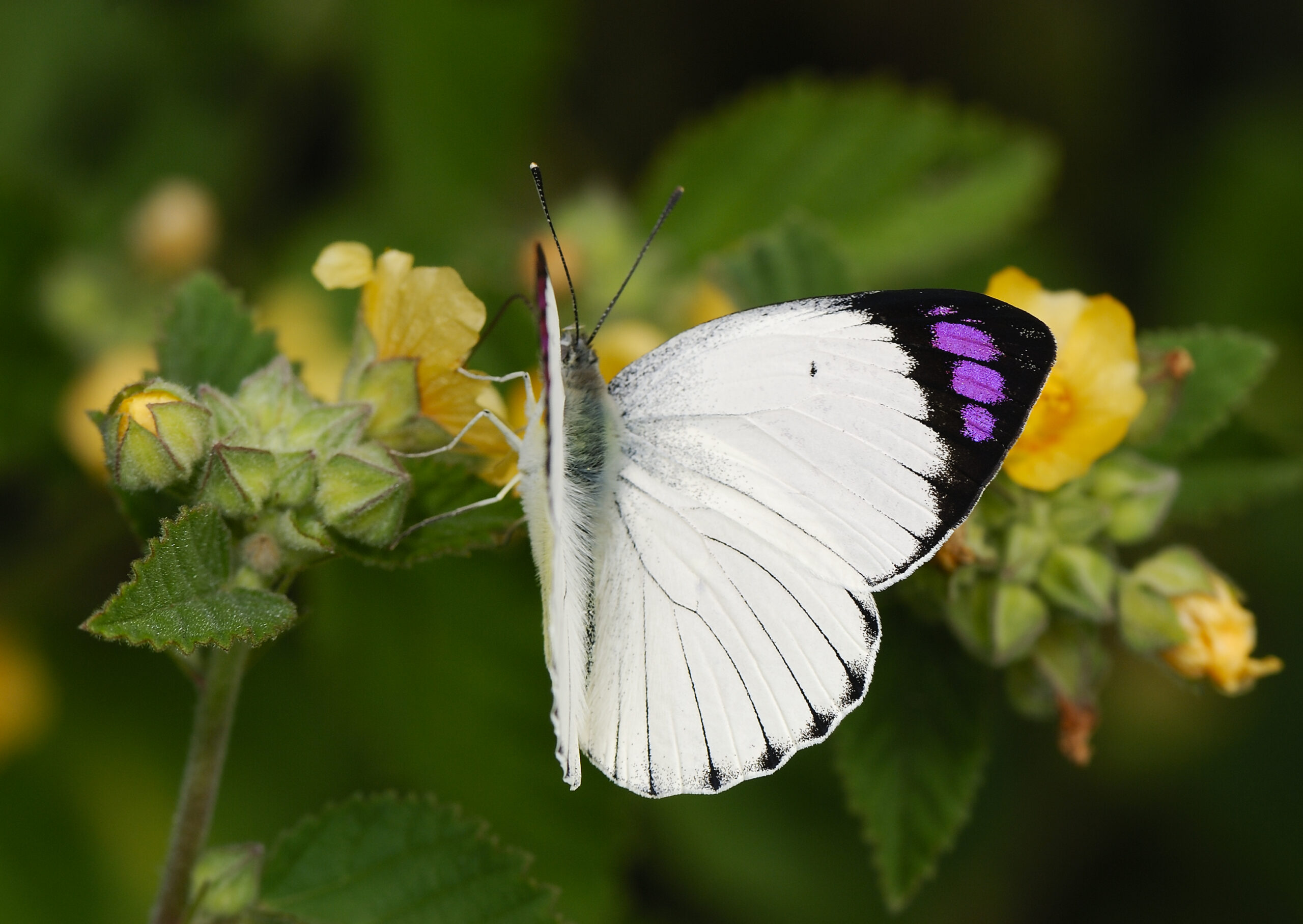
Coast Purple Tip ♂

Colotis erone wet season form erone

Coast Purple Tip distribution map

Where you might see Colotis erone
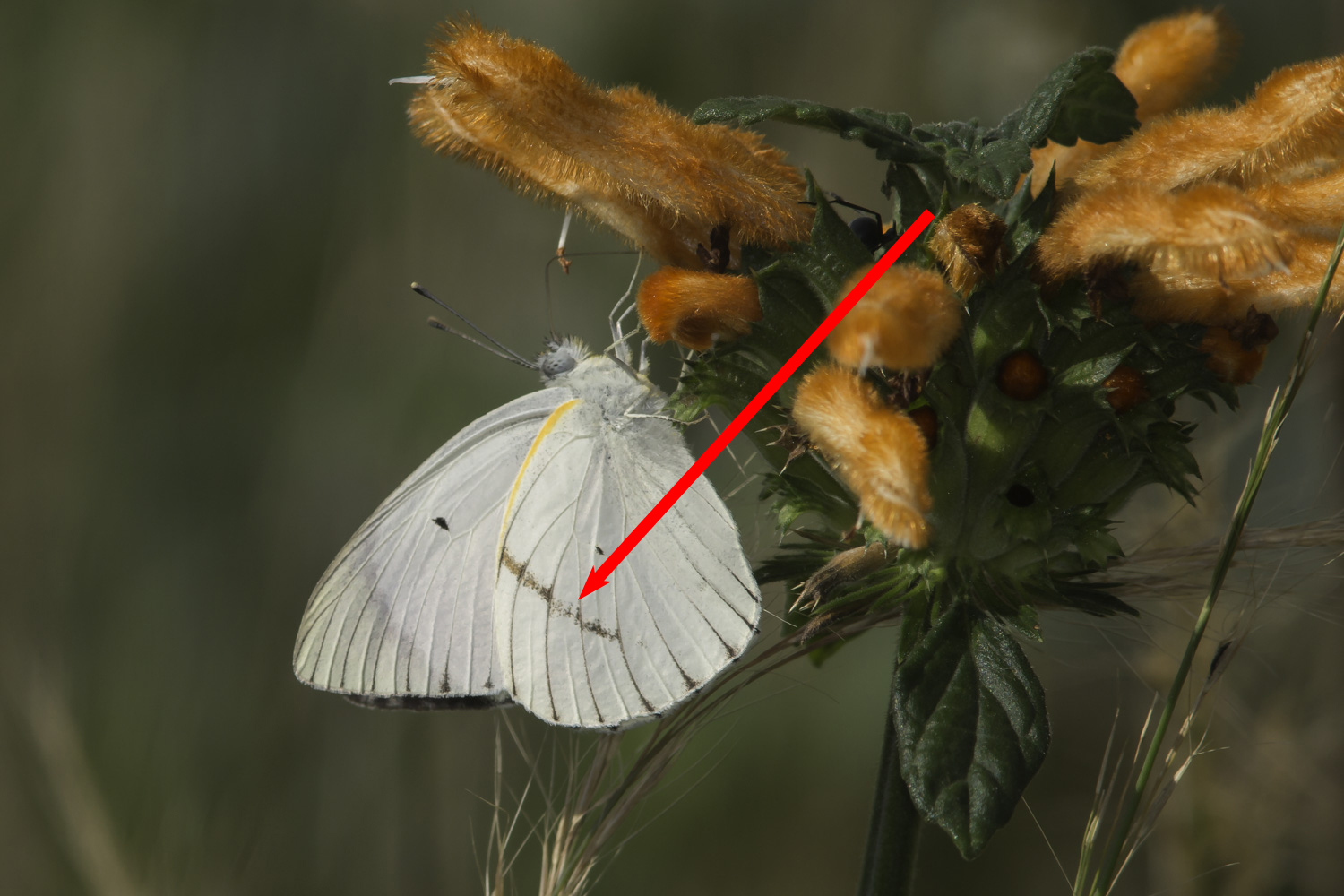
Coast Purple Tip Colotis erone is South Africa’s very own Purple Tip. It’s an endemic species,  only found along a narrow coastal strip from Dwesa and Port St. Johns in the Eastern Cape to Eshowe in KwaZulu-Natal. There are sparse records from further north in Zululand, even Mozambique, but these require confirmation. It mainly inhabits open areas in forests but is found sparsely in sub-escarpment savanna.

The flight behaviour is similar to that of Colotis ione, with males flying slightly lower down. Both sexes show a preference for forest edges and paths.

Its host plant is Forest Bush-cherry Maerua racemulosa.

Coast Purple Tip ♂

Colotis erone wet season form erone
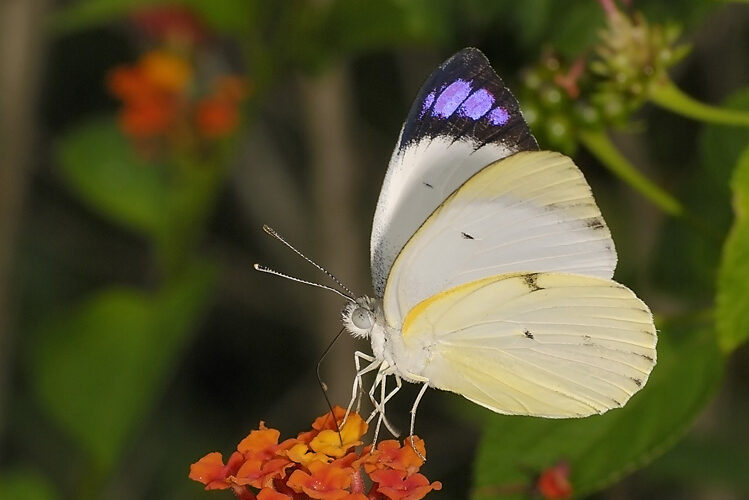
Coast Purple Tip ♂

Colotis erone wet season form erone
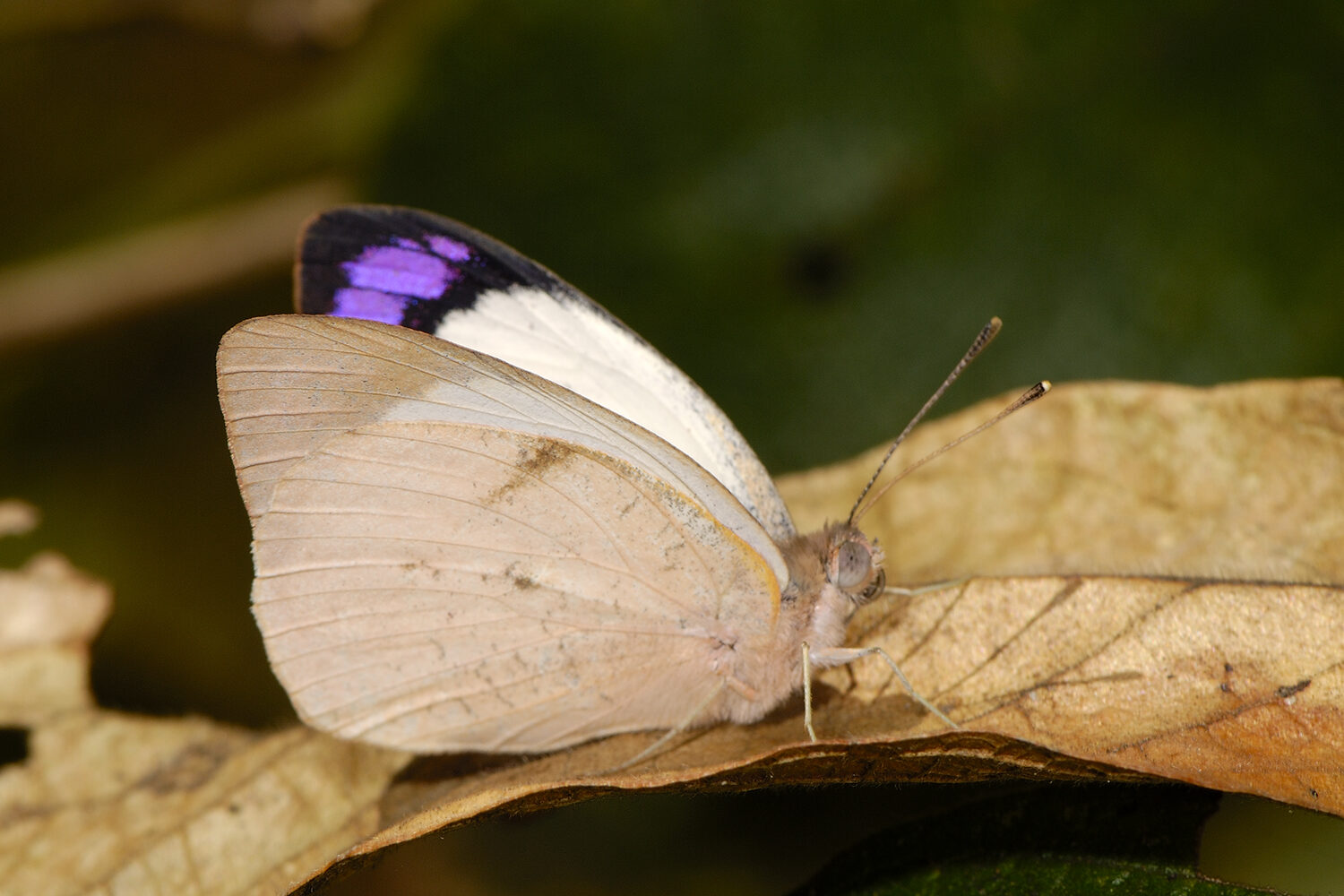
Coast Purple Tip ♂

Colotis erone dry season form jobina
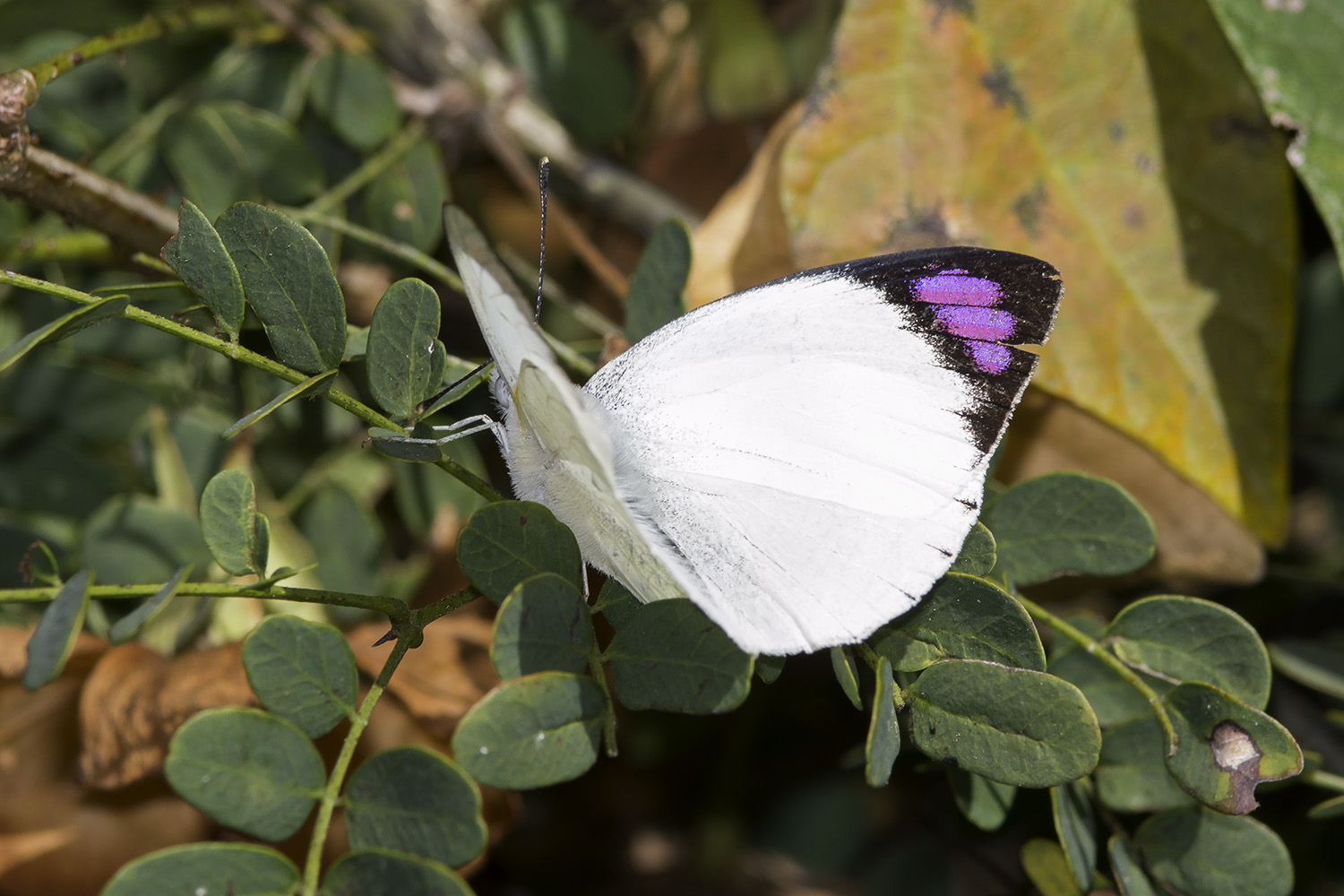
Coast Purple Tip ♂

Colotis erone dry season form jobina
Its colour and markings are similar to those of Colotis ione, but males lack the grey scaling at the forewing apex – this being the main diagnostic feature. The males’ forewing tips have fewer discrete purple cells, usually three, sometimes four, with an occasional small fifth one. The purple is not as strongly iridescent as that of ione although it still has a blue sheen under certain lighting.

The Coast Purple Tip is slightly smaller than the Bushveld Purple Tip. Males have a wingspan of 40–45mm, females, 45–50mm.

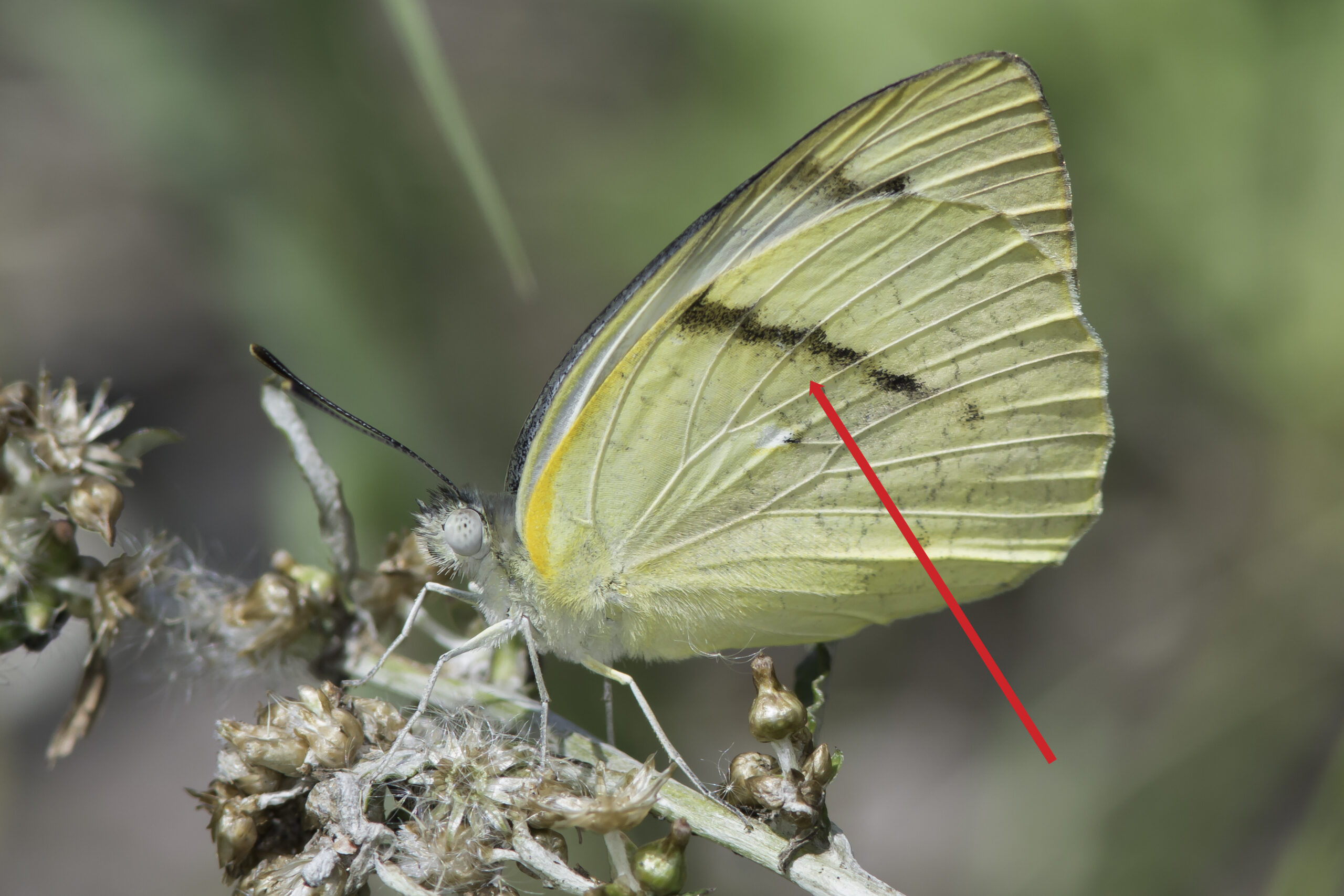
The hindwing underside has a diagonal line running from the costa to vein M2 (arrowed). This occasionally forms a ‘V’ along the vein to the point where it meets the cell.

The Coast Purple Tip shows some seasonal polymorphism, though variation between forms is less pronounced than in the Bushveld Purple Tip. The wet-season male form is erone. Its upper side has heavily black-marked veins and black marginal spots on the hindwing. The hindwing underside ranges from cream to white, with a variable amount of dark marking.

The dry-season male form, jobina, has fewer dark markings on the upper side and is less likely to show black marginal spots. As in many Pierids, the hindwing underside and forewing tips are usually pink, speckled with grey or brown.

Coast Purple Tip ♀

Colotis erone wet season ♀ form natalensis
Coast Purple Tip ♀

Colotis erone wet season ♀ form natalensis
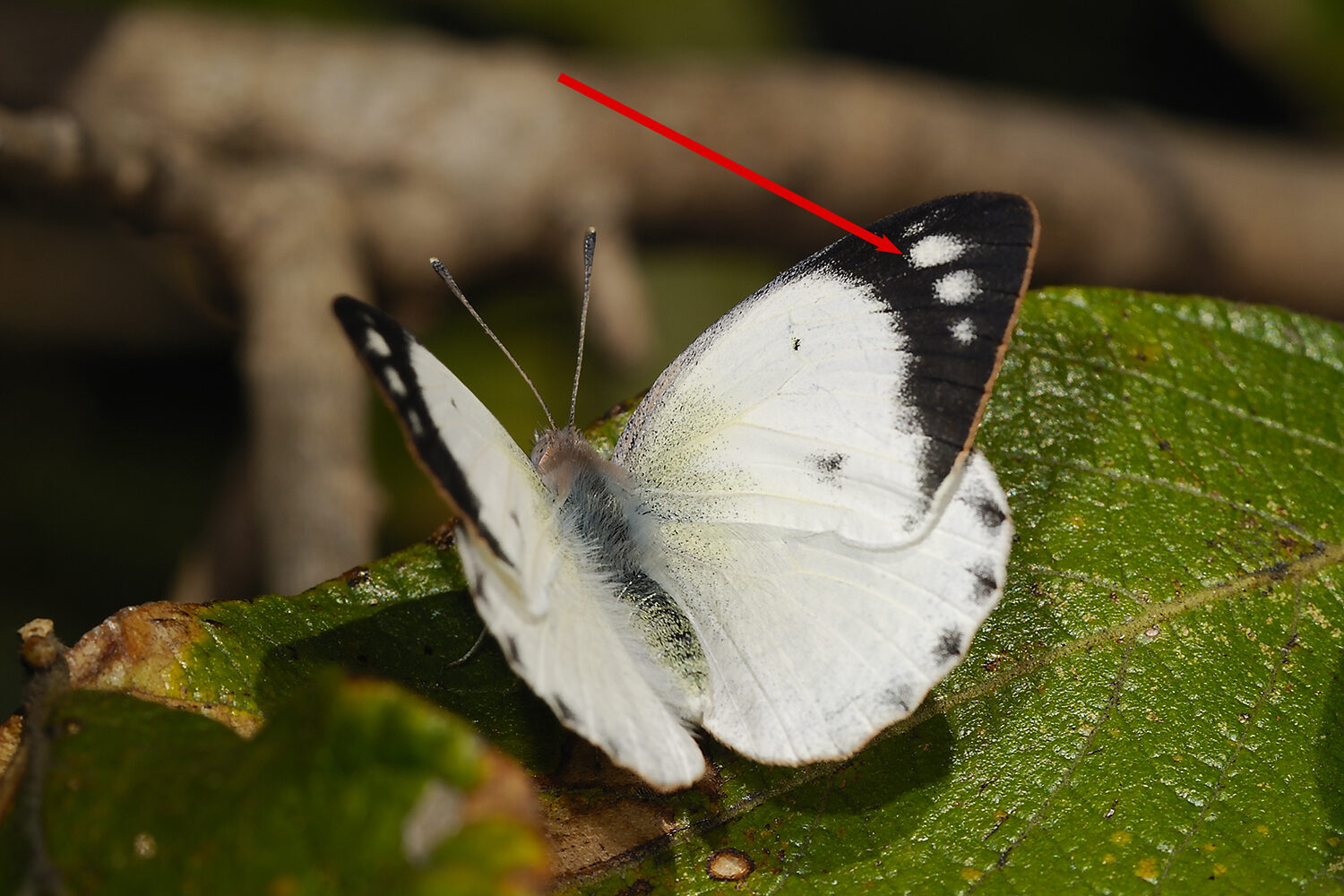
Coast Purple Tip ♀

Colotis erone dry season ♀ form jobina
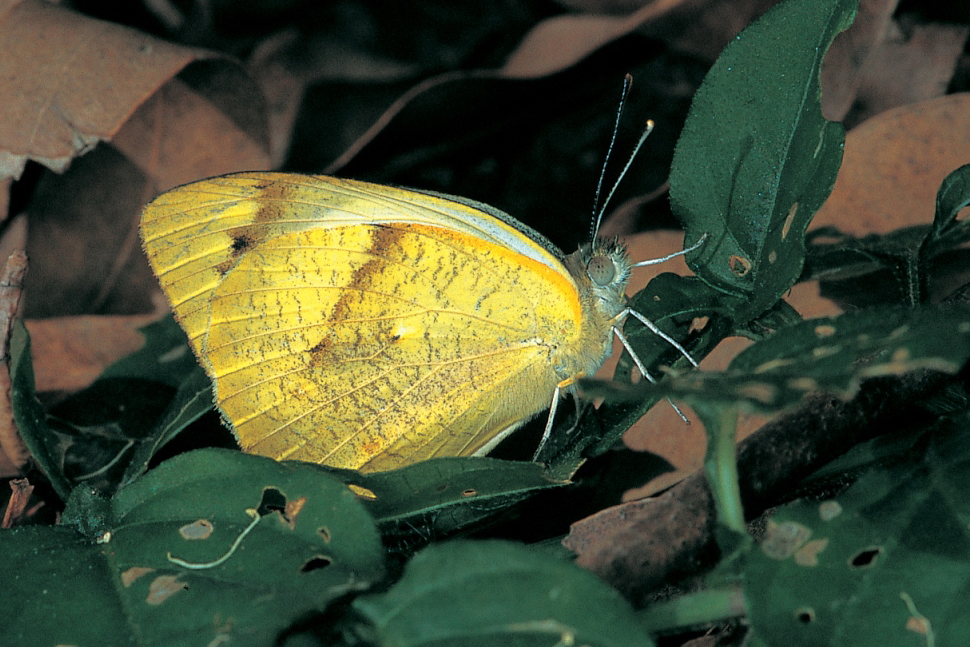
Coast Purple Tip ♀

Colotis erone dry season ♀ form jobina
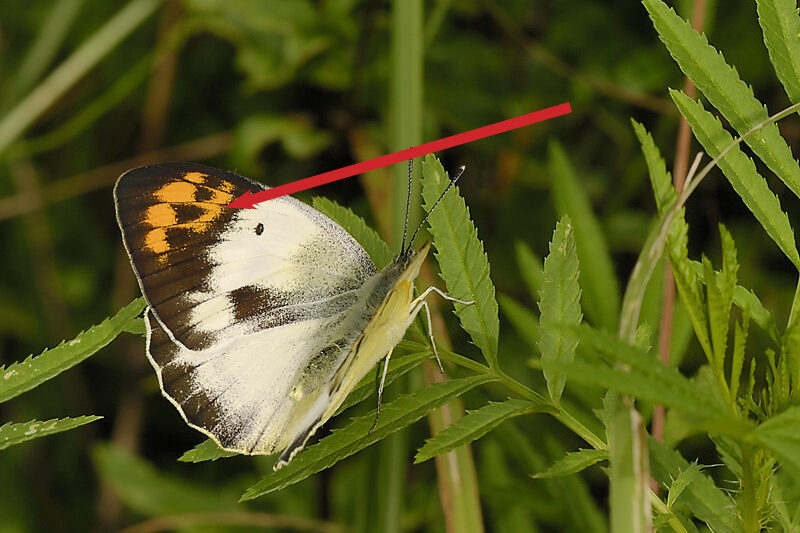
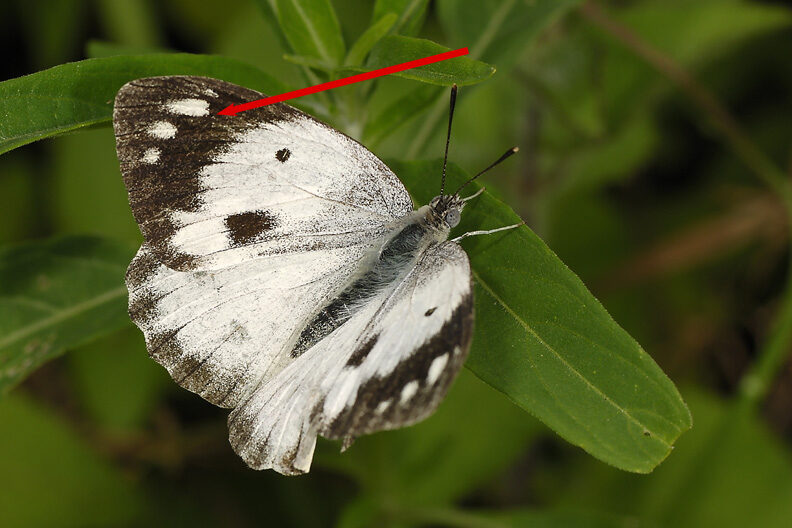
The wet-season female with black wingtips is form natalensis. The wing tips contain three, occasionally four, white cells in the black (arrowed). Her hindwing underside is usually creamy yellow with a conspicuous black diagonal mark (arrowed). The forewing upper-side bases are grey, and the wing margins are heavily suffused with black or grey.

Her dry-season counterpart, form jobina, has reduced dark markings on the upper side. The underside is often bright yellow.

The wet-season form of the orange-tipped female is form erone. Like form natalensis, she has extensive dark markings, but the orange forewing tip is conspicuous and crossed by a row of black spots (arrowed). The underside is usually similar to that of form natalensis, although the forewing-tip underside shows some of the upper-side orange.

The dry-season orange-tipped form, millari, is rare. Compared with form erone, she has restricted dark markings on the upper side. Her underside is pinkish buff, speckled with grey or brown, as in other dry-season ‘Tips’.

Coast Purple Tip ♀

Colotis erone wet season ♀ form erone
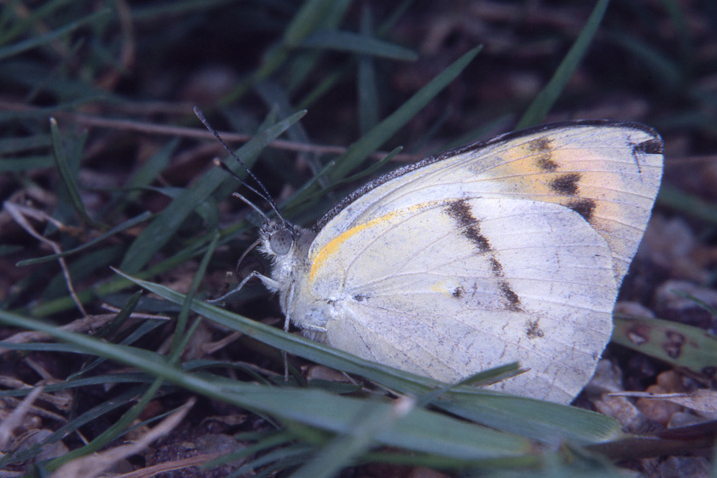
Coast Purple Tip ♀

Colotis erone wet season ♀ form erone
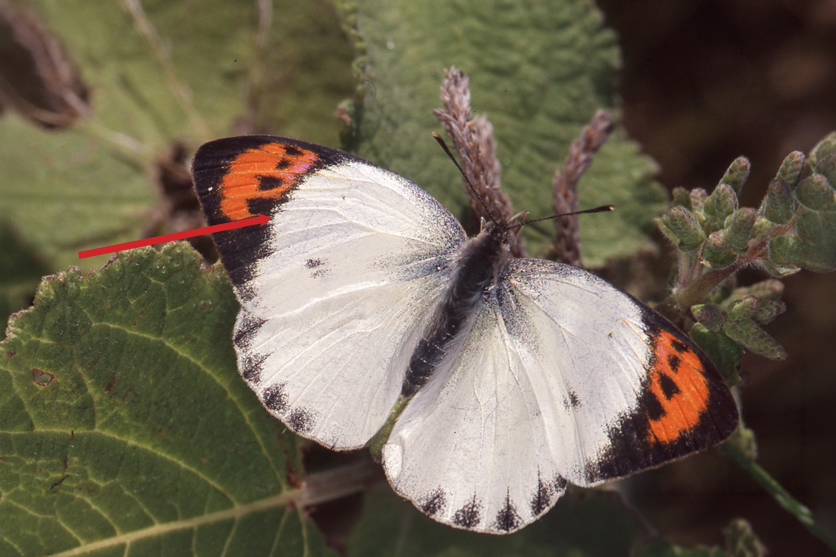
Coast Purple Tip ♀

Colotis erone dry season ♀ form millari
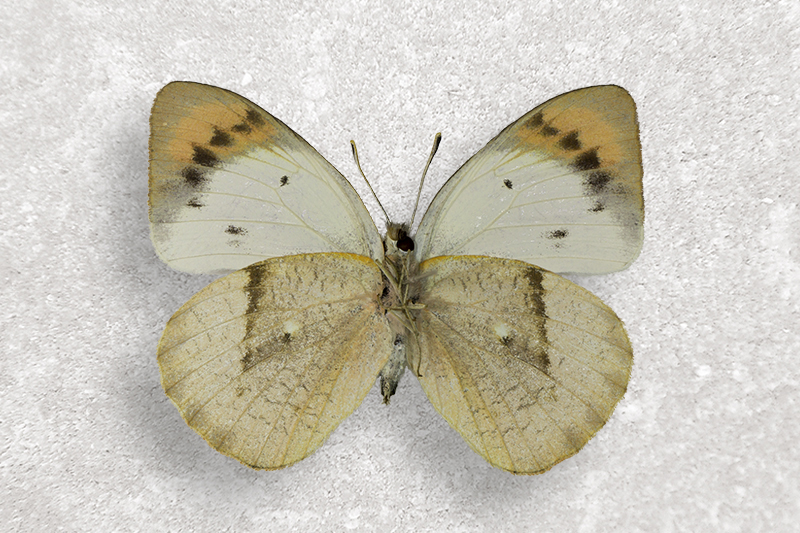
Coast Purple Tip ♀

Colotis erone dry season ♀ form millari
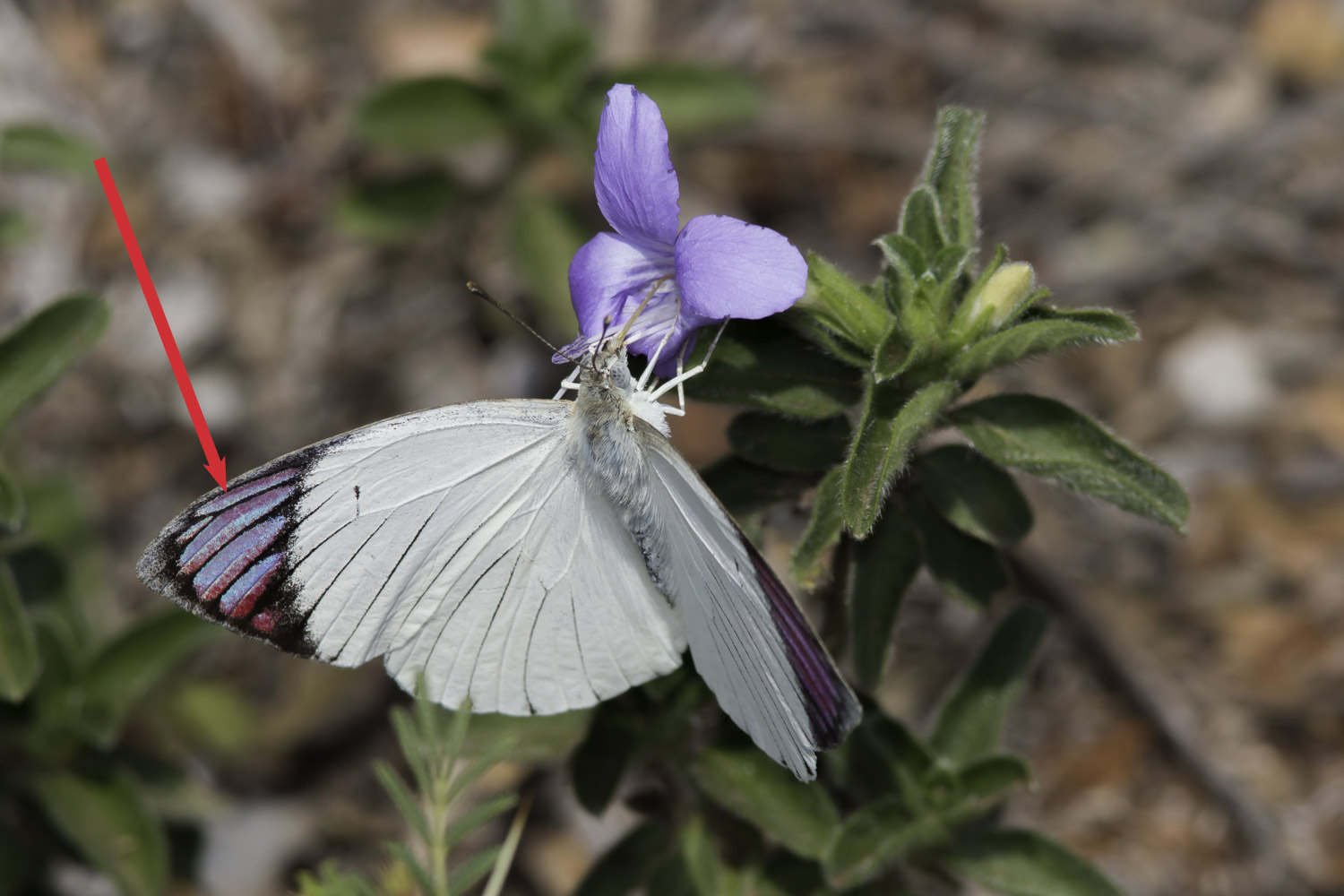
Queen Purple Tip ♂

Colotis regina form regina
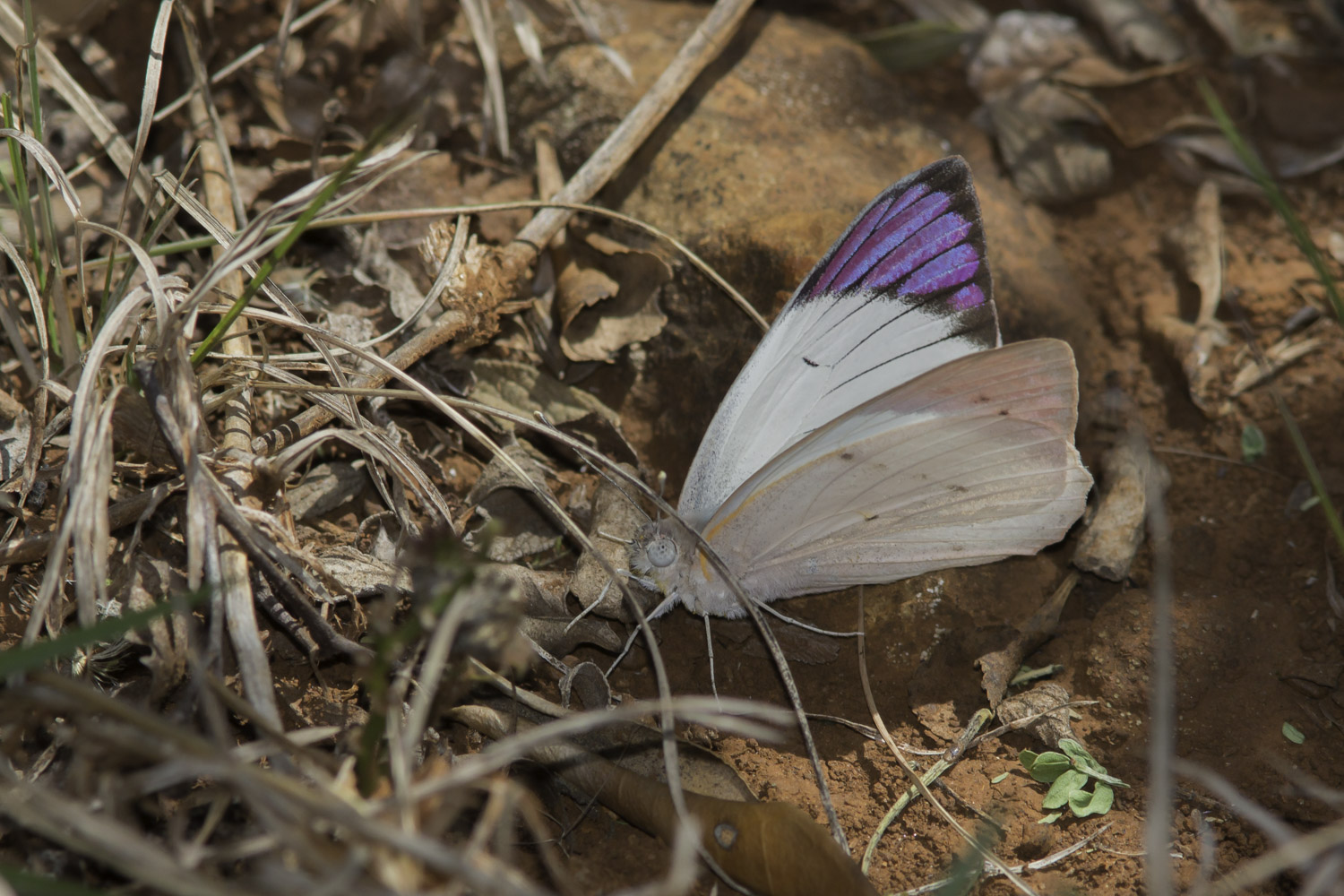
Queen Purple Tip Colotis regina is South Africa’s largest Purple Tip, recognised chiefly by its size. Males have a wingspan of 45–60mm, and females 48–62mm; seasonal variation affects size, with dry-season individuals usually smaller. The forewing apical tips cover almost half the wing.

Colotis regina flies fast, crossing open country rapidly and often stopping at flowers or resting on the ground. Males may follow ridges and circle prominent trees or rocks. They do not hold hilltop territories but may pause long enough to be photographed. Females are more often seen at flowers.

The main distinguishing feature of the male is the purple forewing tip, which has a greenish-blue iridescence (arrowed) over the purple, rather than the royal blue sheen seen in the other two species.

The male dry-season form, regina, has no black lines along the veins, or only faint ones. Its underside has the pinkish colouration typical of dry-season ‘Tips’. The wet-season form, anax, has heavier black veins on the upper side. Its underside is white, sometimes strongly tinged with yellow.

The caterpillars feed on Shepherd’s-tree Boscia albitrunca and Willow-leaved Shepherd’s-tree Boscia salicifolia, although a Capparis species has been recorded as a host in East Africa.

It is widely distributed in Africa: from the bushveld of South Africa, Namibia, and Zimbabwe north to Angola, and from Botswana through Zambia, DRC, Uganda, Tanzania, and Kenya to Somalia.

Queen Purple Tip ♂

Colotis regina form regina

Queen Purple Tip ♂

Colotis regina form anax
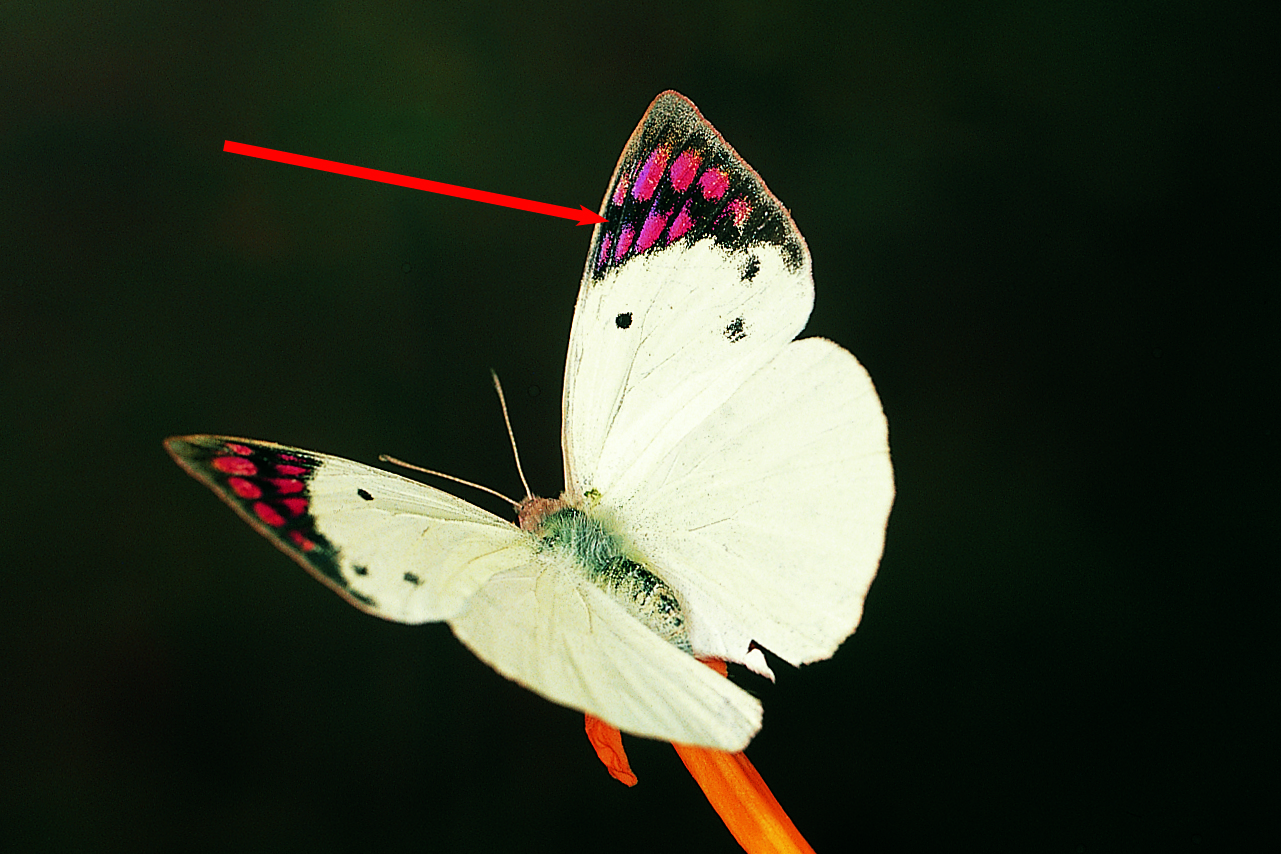
Unlike Colotis erone and Colotis ione, this species has no orange-tipped female forms. However, it does show sexual dimorphism. Males often have their wing veins picked out in black and they lack spots or bands across the forewing apical tips; females have these bands.

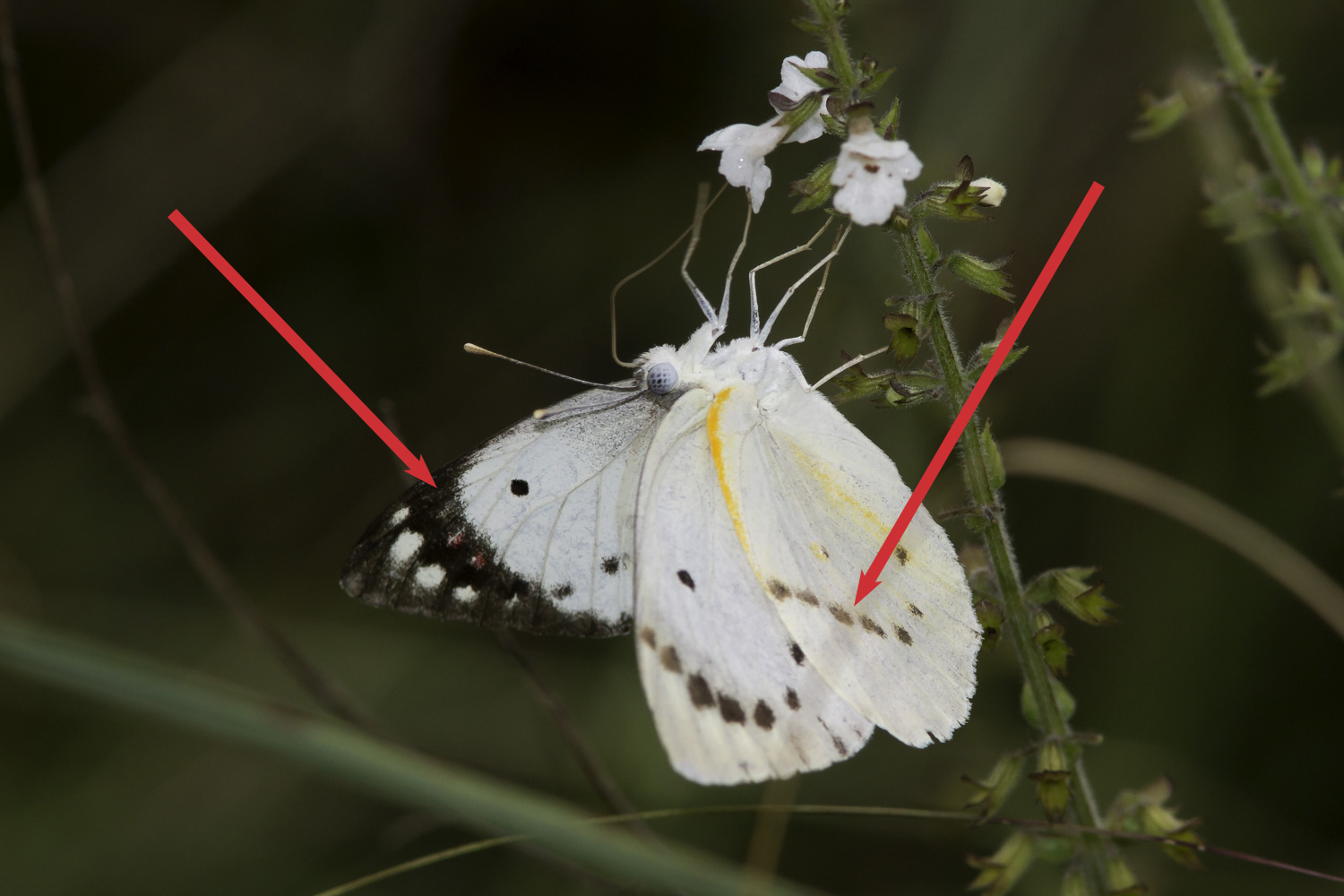
Females of Colotis regina have black or dark brown forewing tips with a transverse band (arrowed) that divides the ‘cells’. These cells may be non-iridescent purple or white, or a mix of the two. The dry season form regina has reduced dark markings on the upper side.

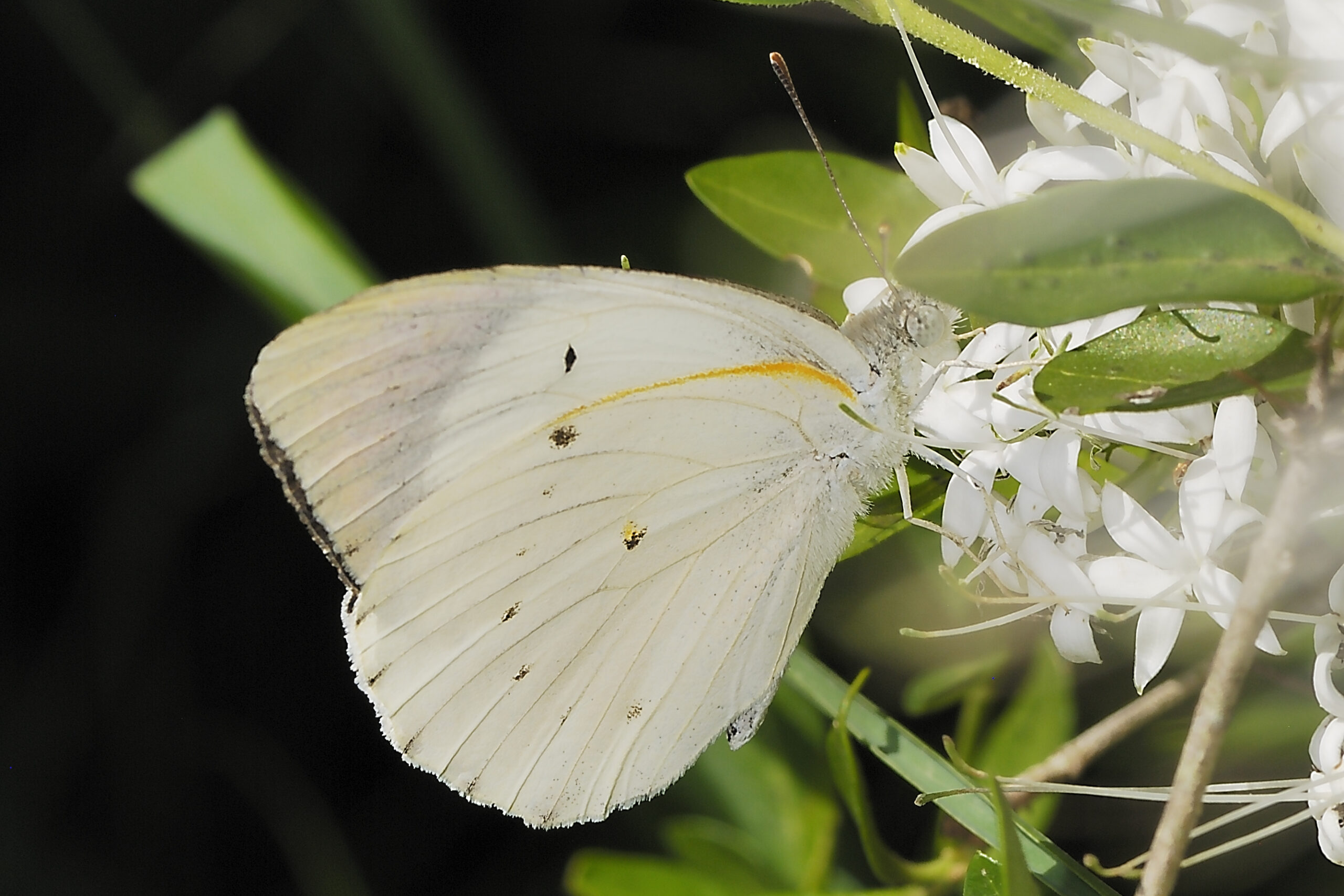
The forewing underside tip has a dark patch where the upper-side pattern shows through. The hindwing underside is usually plain, often with a square postdiscal band angled towards the margin in area M2 or M3 (arrowed).

Queen Purple Tip ♀

Colotis regina dry season form regina
Queen Purple Tip ♀

Colotis regina wet season form anax
Queen Purple Tip ♂

Colotis regina wet season form anax

Queen Purple Tip ♂

Colotis regina dry season form regina
Southern Lilac Tip Colotis celimene amina is the smallest ‘Purple Tip’ and one of the most colourful. Its male has a wingspan of 32–40mm; the female is 34–40mm. It’s quite rare and is only found in the most arid savanna areas of South Africa – northern KwaZulu-Natal (Tugela Valley and iMfolozi National Park), central Gauteng, the Marico River of North-West Province, and the rain shadow of the Wolkberg in Limpopo and Mpumalanga. It extends north into Zimbabwe, Mozambique and Zambia.

The nominate subspecies extends to Ethiopia, Uganda, Kenya, and Tanzania; other subspecies are found in West Africa.

Southern Lilac Tip ♂

Colotis celimene amina
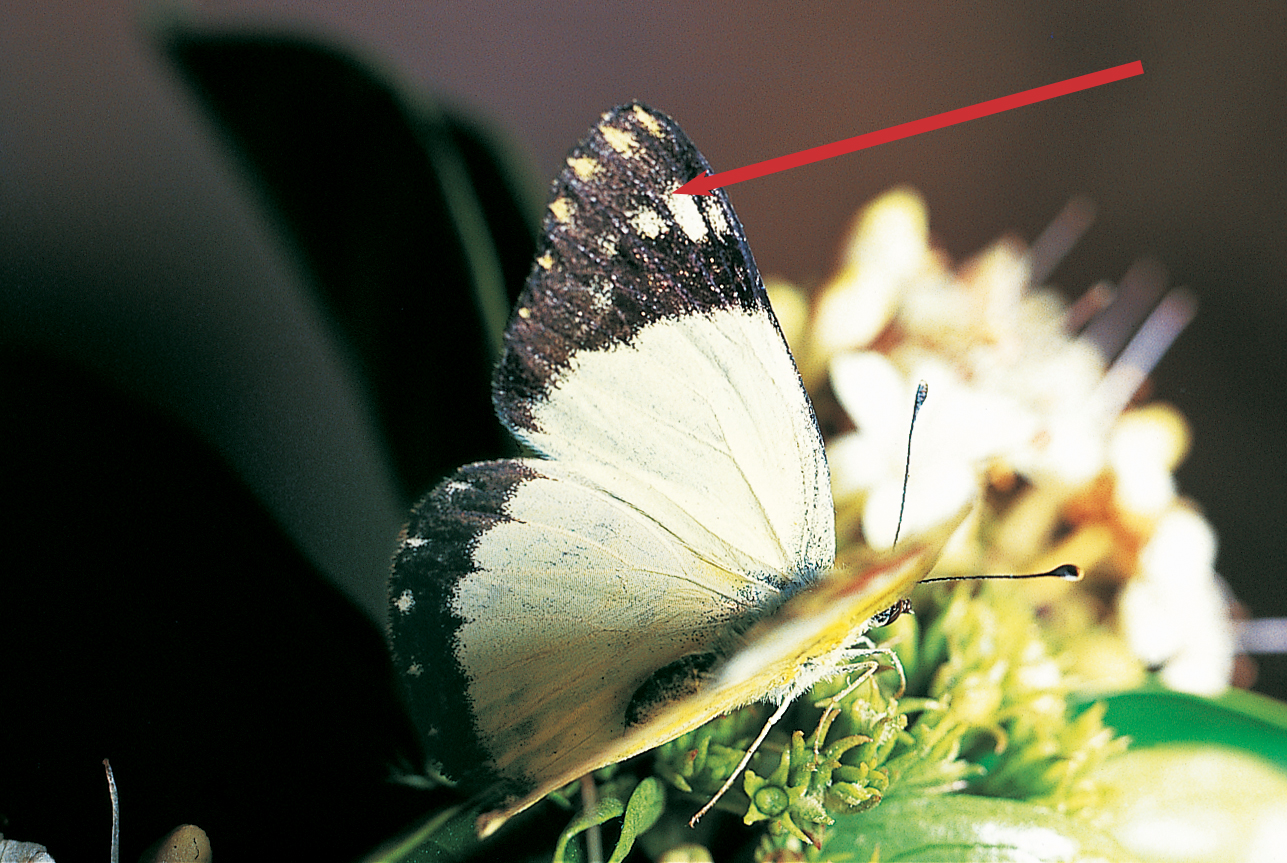
Southern Lilac Tip ♂

Colotis celimene amina
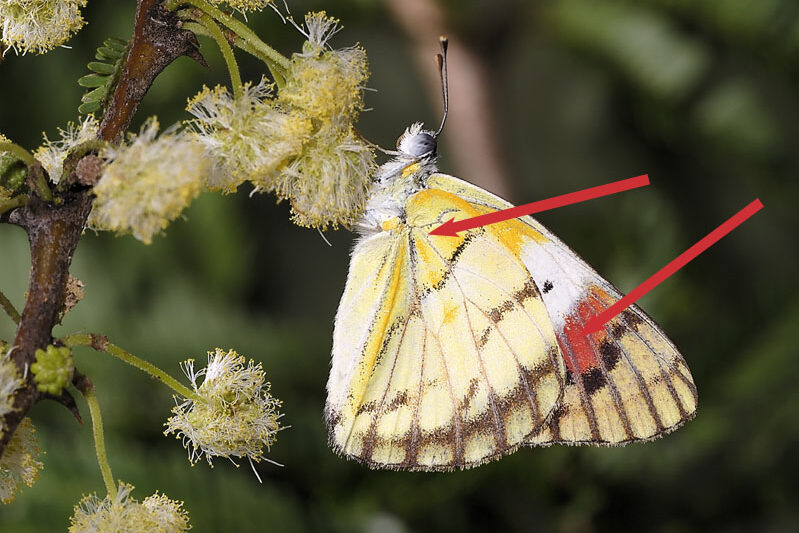
Southern Lilac Tip ♀

Colotis celimene amina
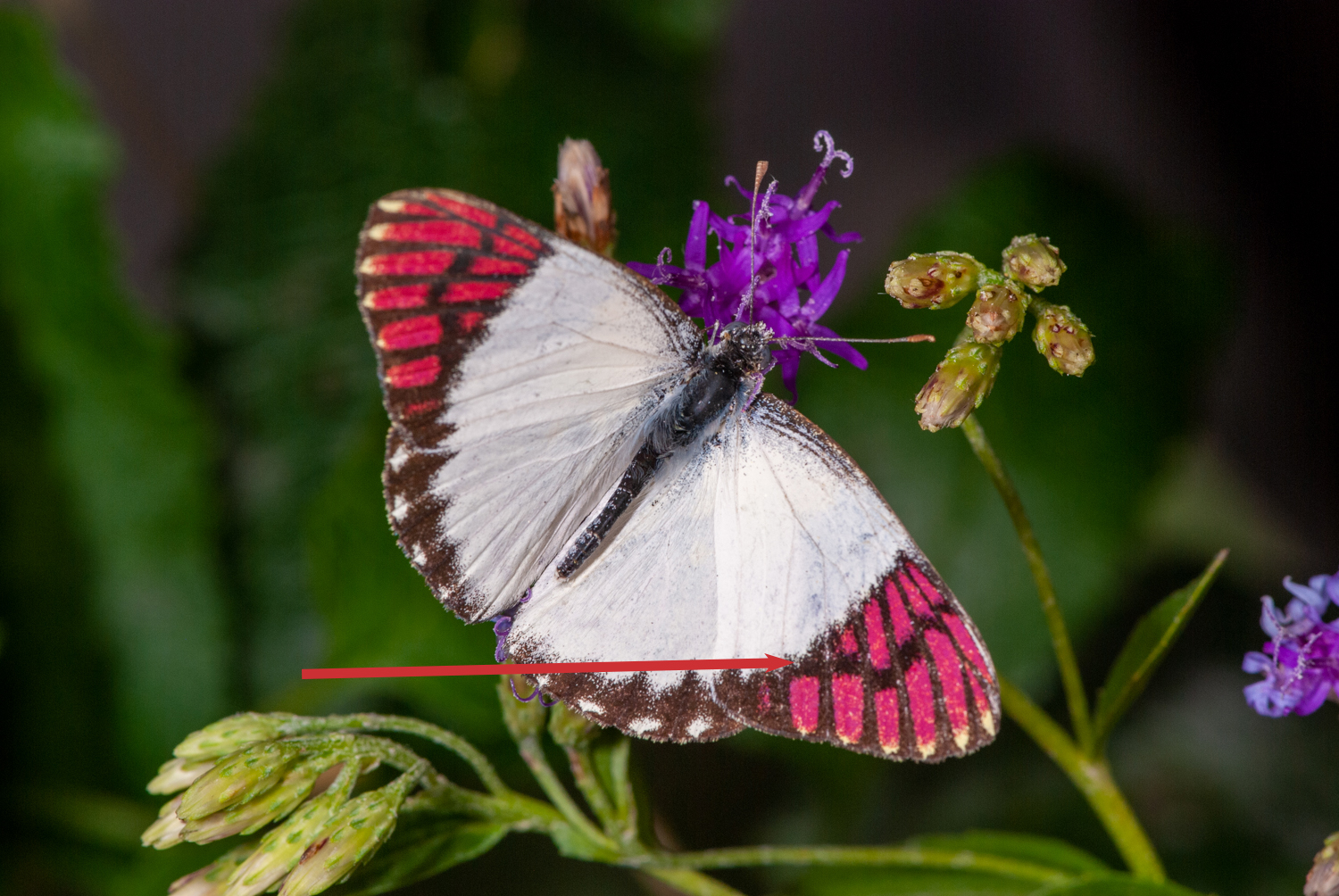
The males’ forewing tips cover roughly half of the wing area. Unlike the other local ‘Purple Tips’ the tip has a black bar crossing it (arrowed). The colour is deep lilac with little or no iridescence or metallic character.

Southern Lilac Tip females have little red or purple colour on their upper sides; they are black-and-white (arrowed), sometimes tinged with a small amount of red. Both sexes have colourful undersides crossed by dark bands and yellow wing bases (arrowed). The forewing tips carry red patches outlined with black (arrowed).

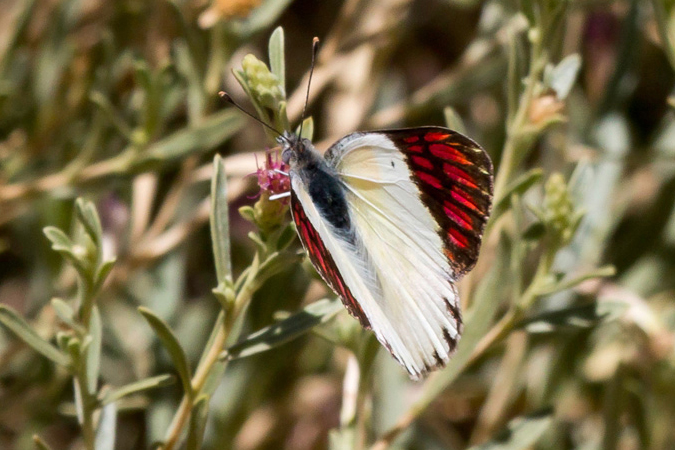
Desert Lilac Tip ♂

Colotis celimene pholoe © Peter Sharland
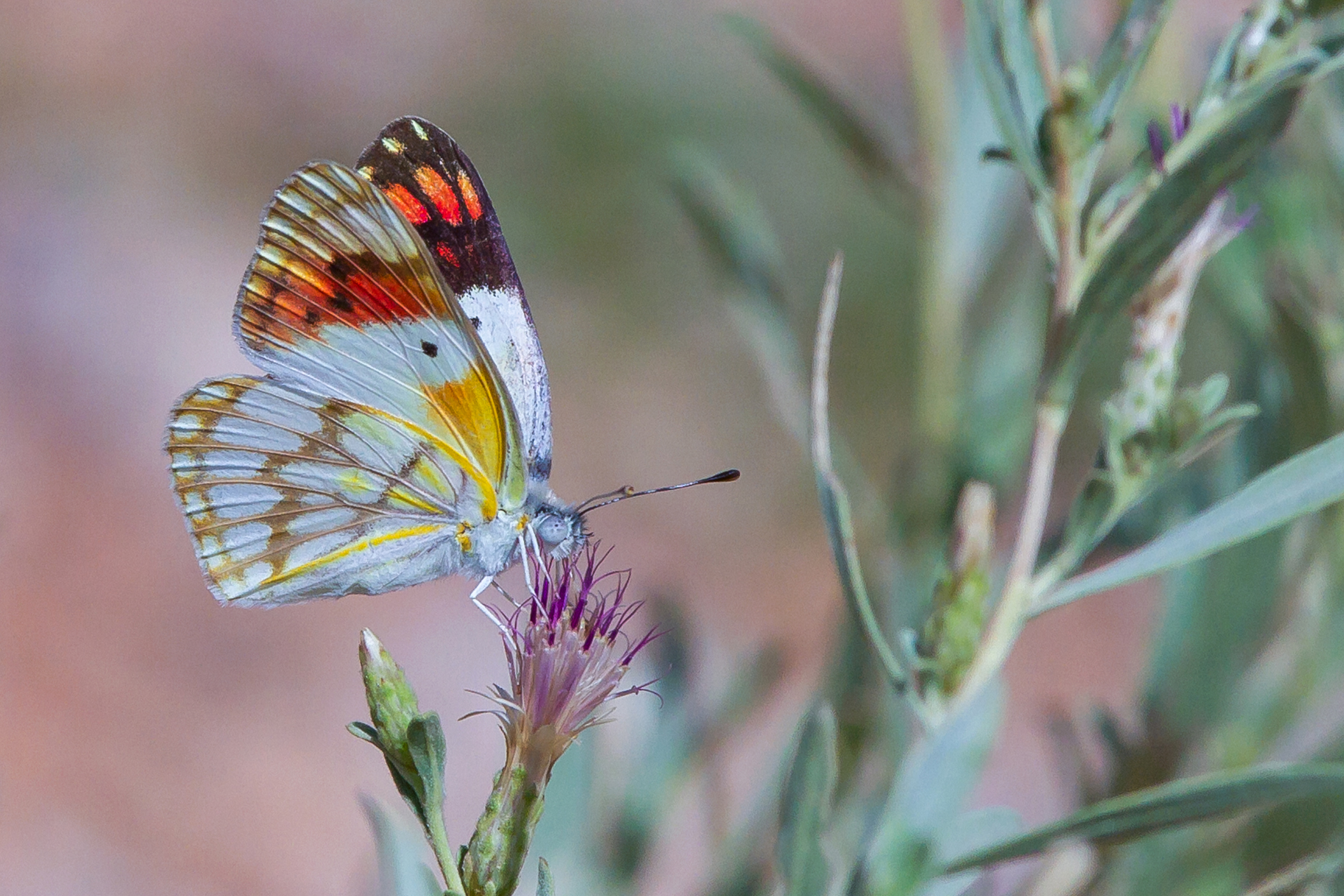
Desert Lilac Tip ♀

Colotis celimene pholoe © Margaret Hardaker
The Desert Lilac Tip Colotis celimene pholoe is found mainly in Namibia but occurs in the Northern Cape (Tswalu and the Richtersveld).

Desert Lilac Tip females have extensive reddish cells in their wing tips.

Colotis celimene is uncommon and difficult to detect among other ‘whites’ when they are swarming. It is a fast flying insect that usually travels in a straight line one to two meters above the ground. It may visit flowers or rest on the ground. Males occasionally drink from wet mud. They are noted for their territorial behaviour, which is unusual for a Pierid. They select an isolated tree some 4-5 meters tall with a thin structure and dense foliage, then hover next to it, circling and moving to and fro about 2-4 meters up, occasionally perching and chasing butterflies that have infringed on their territory.

The caterpillars feed mainly on Shepherd’s-tree Boscia albitrunca and Willow-leaved Shepherd’s-tree Boscia salicifolia although other Boscia species as well as Capparis and Maerua species are used.

Lemon Tip ♂

Teracolus subfasciatus

Lemon Tip ♀

Teracolus subfasciatus
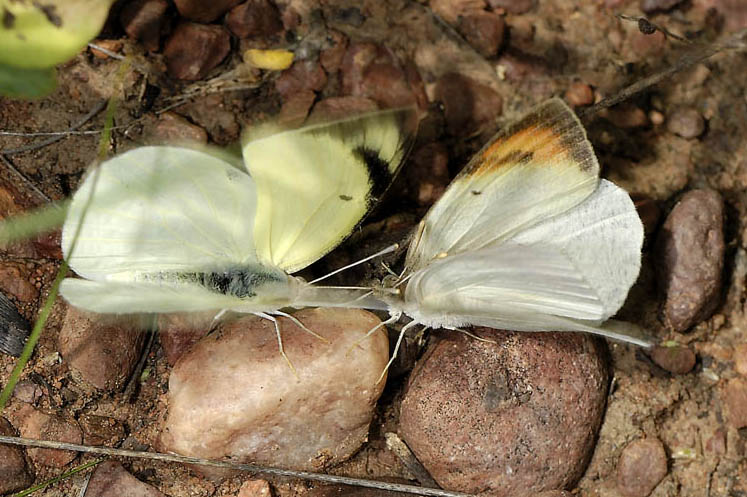
Lemon Tip mating pair ♀ to R

Teracolus subfasciatus
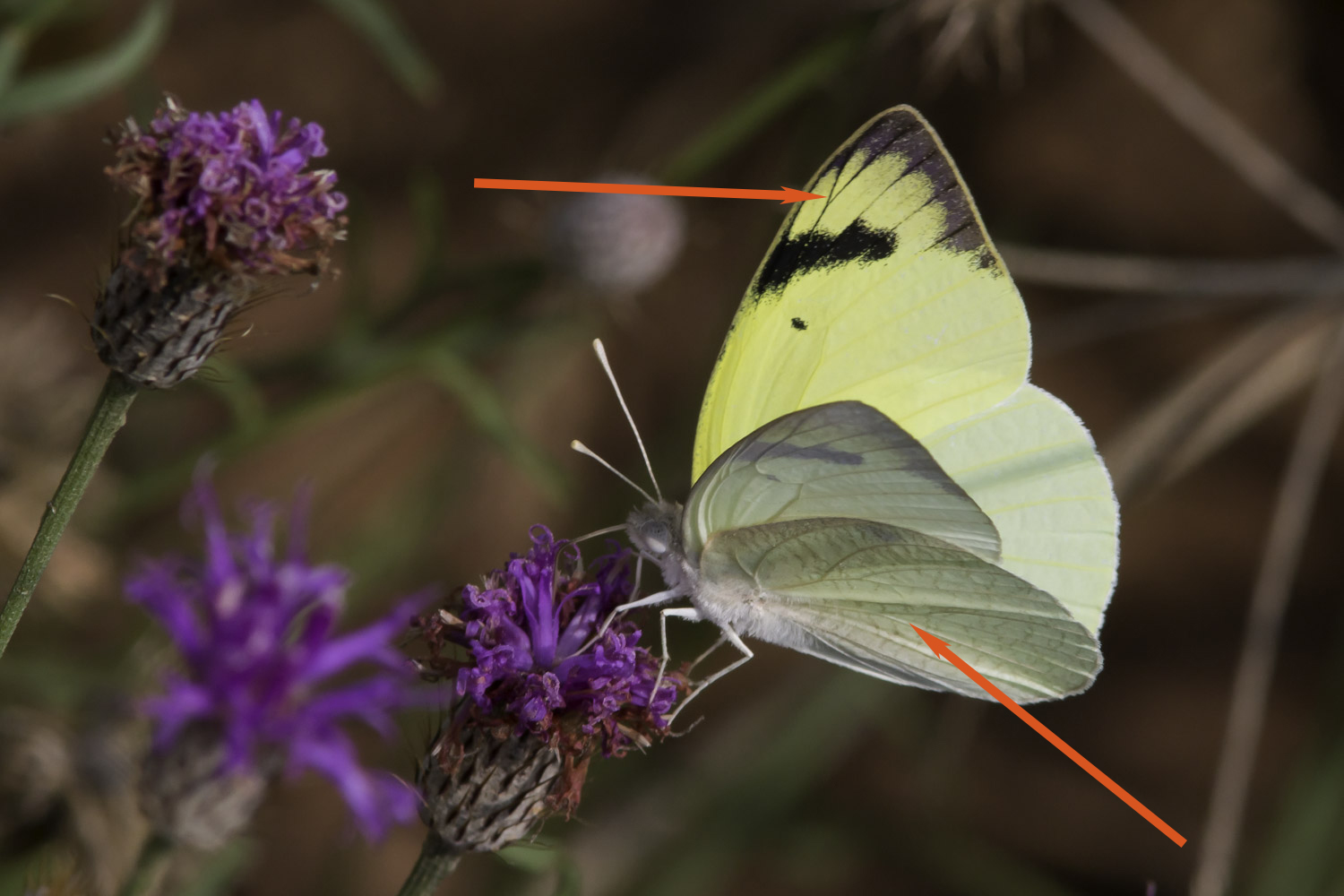
The Lemon Tip, Teracolus subfasciatus is from a genus closely related to Colotis and until recently was included in it. Males have a wingspan of 45–52mm, females 48–55mm. The yellow ground colour and pointed, slightly falcate forewing tip is instantly recognisable among Tips.

The male’s forewing tip is the same yellow colour as the rest of the wing (arrowed). It has a black basal edge and is bounded by a dark grey margin. The tip is covered with a flame-like blue iridescence, which is typical of the genus Teracolus.

The species shows sexual dimorphism. Females are a less intense yellow hue (they are often white) and have orange forewing tips (arrowed) with no iridescence. Form ganymedes is found in the arid areas of Botswana and Namibia; it is much paler than the form subfasciatus found in South Africa.

The underside hindwing of both sexes is pale greenish white finely striated with pale grey-brown; a white-edged darker line crosses the hind wing diagonally (arrowed).

Both sexes have rapid, direct flight, 1-2m above the ground, settling on mud and to feed on flowers.

It’s found in arid savanna thornveld from northern South Africa to Namibia and Angola, Botswana, western Zambia, Zimbabwe, Mozambique and eSwatini. The caterpillars feed on The caterpillars feed on Shepherd’s-tree Boscia albitrunca and Willow-leaved Shepherd’s-tree Boscia salicifolia.

Banded Gold Tip ♂

Teracolus eris eris form eris
Banded Gold Tip ♂

Teracolus eris eris form eris
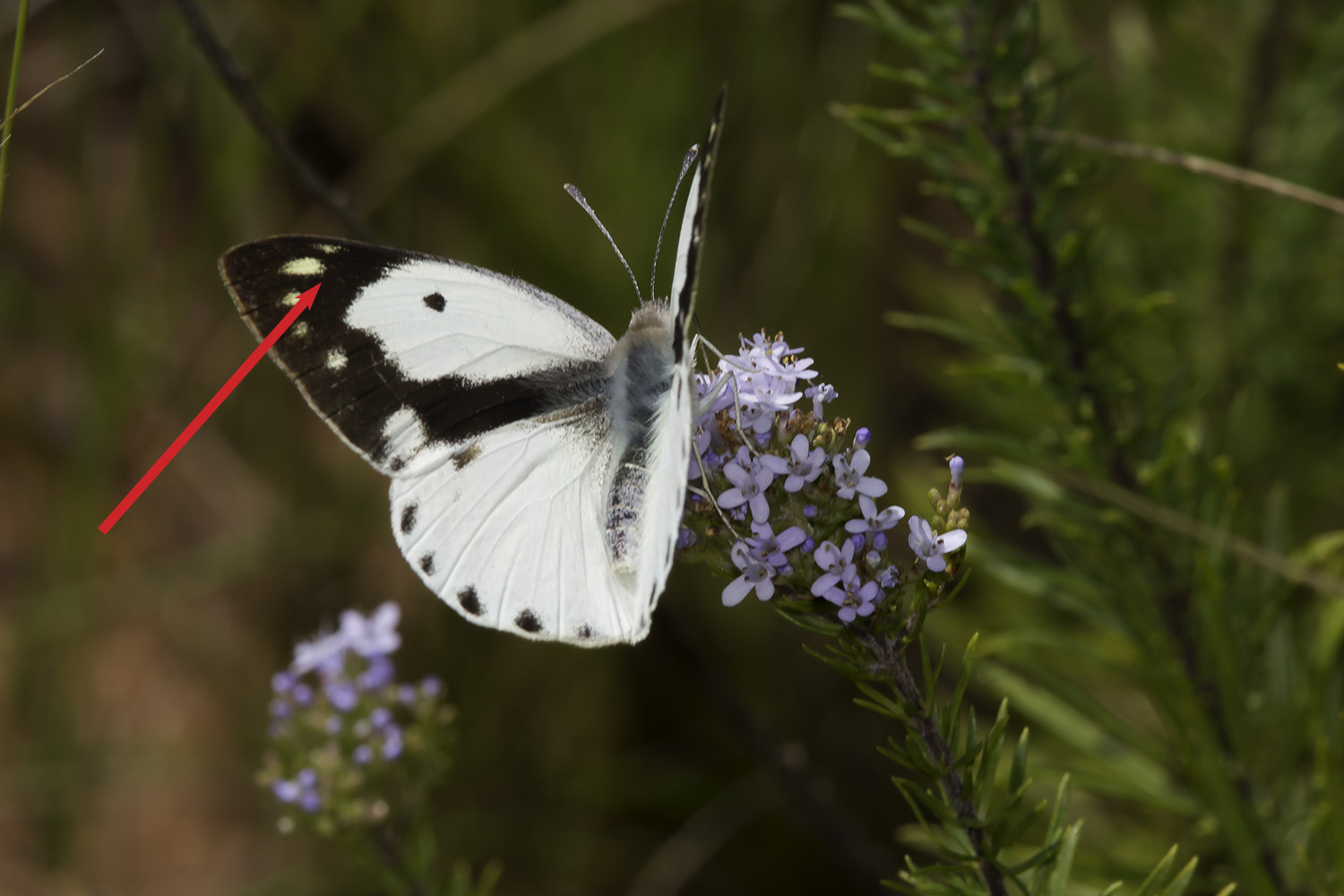
Banded Gold Tip ♀

Teracolus eris eris form eris
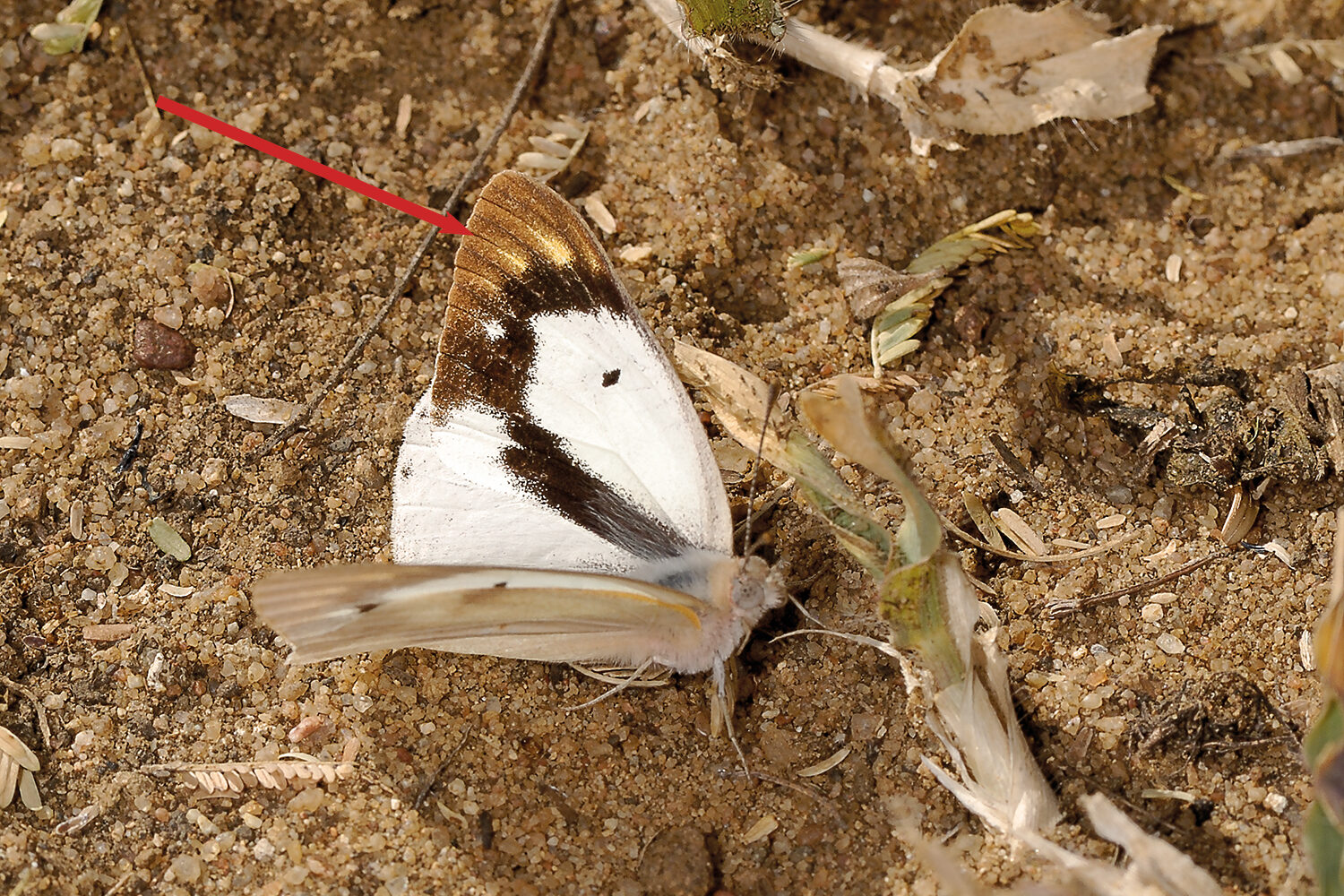
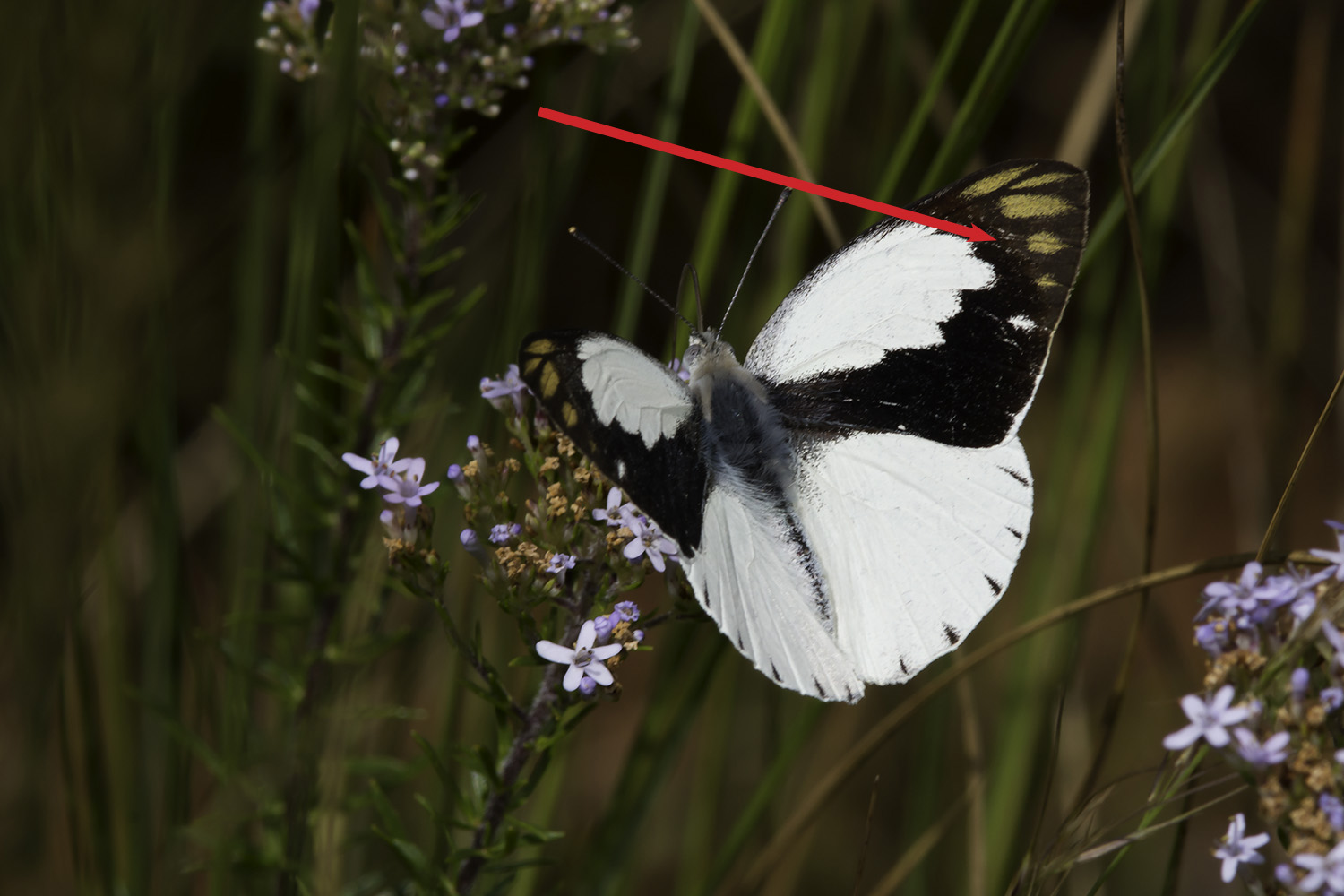
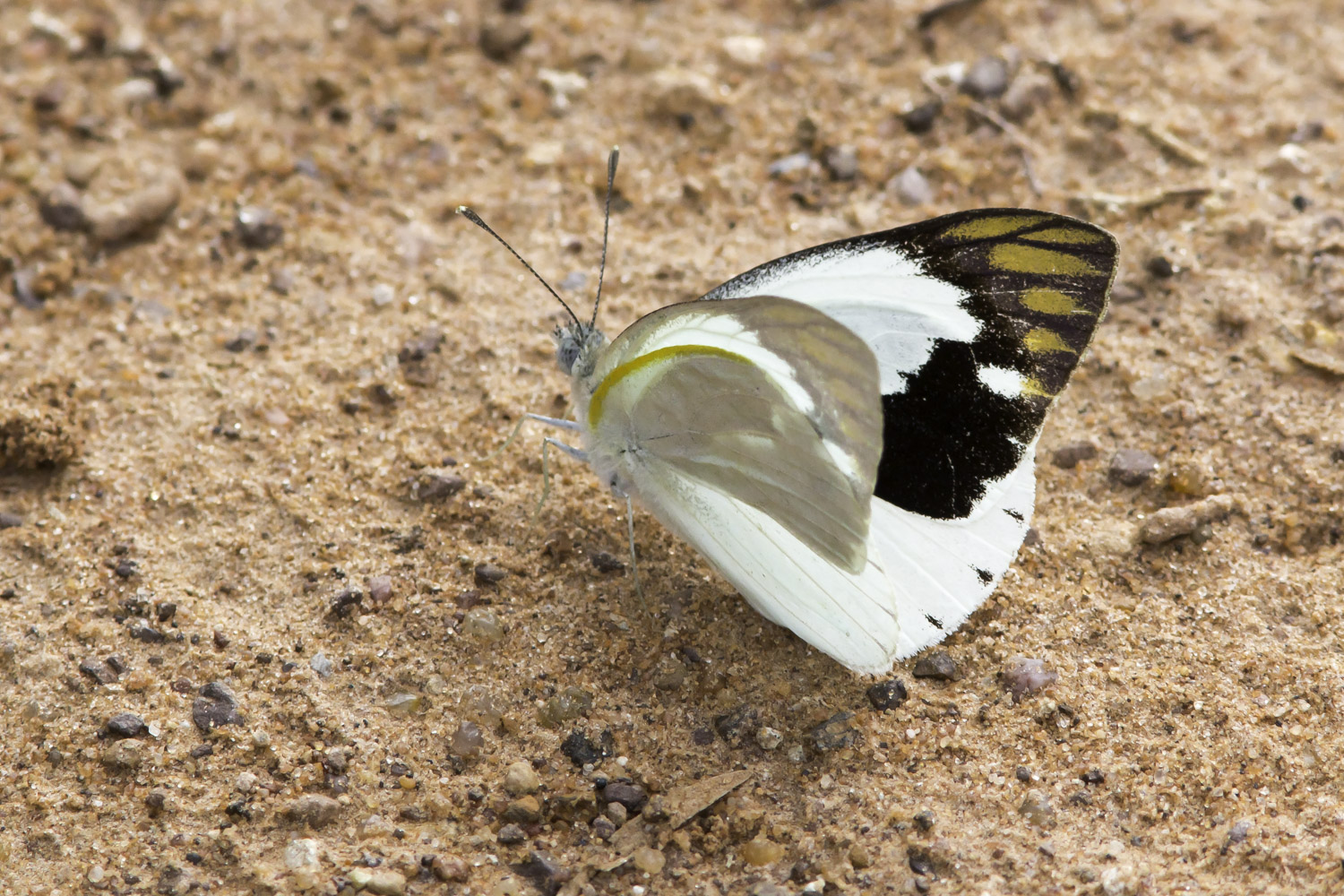
The Banded Gold Tip, Teracolus eris eris, is related to the Lemon Tip, as shown by the fugitive blue iridescence over the male’s forewing tip (arrowed). Its contrast with the yellow cells in the tip gives a metallic gold impression, which explains the common name.

The broad, conspicuous black band across the inner forewing margin in both sexes is easy to see in flight and accounts for the ‘Banded’ part of the common name.

It’s found across the drier savanna areas of sub-Saharan Africa from the Nama Karoo-Albany Thicket interzone to the moister thornveld areas. It’s also found on the Arabian Peninsula.

Like other Teracolus species it has a rapid direct flight from 1-3 meters above the ground. Females fly a little more slowly but are still swift on the wing. They are fond of flower nectar and are often found in mud puddle clubs.

Its host plants include Karoo Shepherd’s-tree Boscia oleoides, Shepherd’s-tree Boscia albitrunca and Willow-leaved Shepherd’s-tree Boscia salicifolia. It also uses Capparis and Maerua species.

The wet-season form, eris, has a plain white hindwing underside through which the black upper-side markings show through. Females have a black forewing tip like the male, but the cells within it are white (arrowed), and it has no blue iridescent sheen.

Banded Gold Tip ♀

Teracolus eris eris form fatma

Banded Gold Tip ♂

Teracolus eris eris form fatma
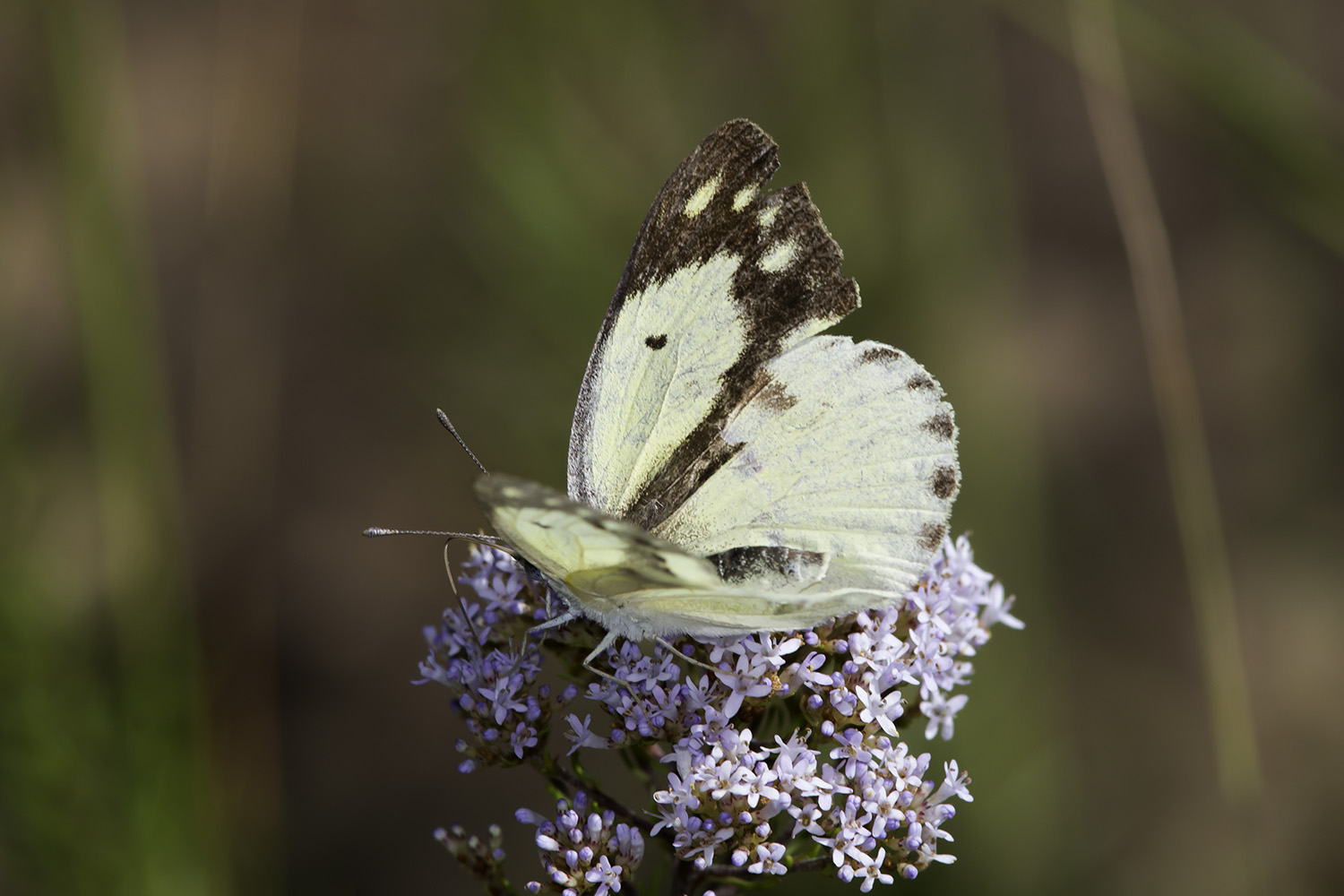
Banded Gold Tip ♀

Teracolus eris eris form abyssinicus
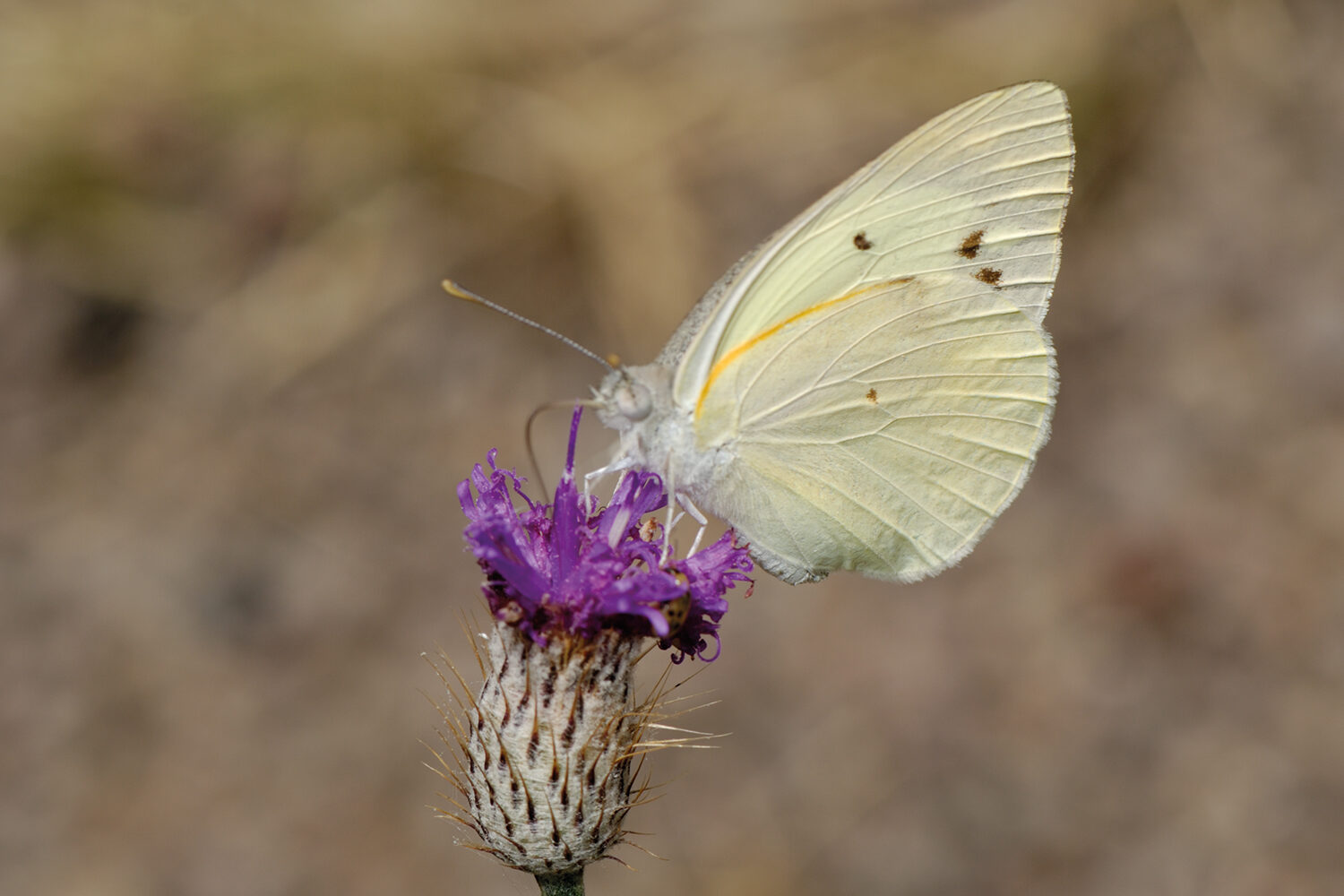
Banded Gold Tip ♀

Teracolus eris eris form abyssinicus
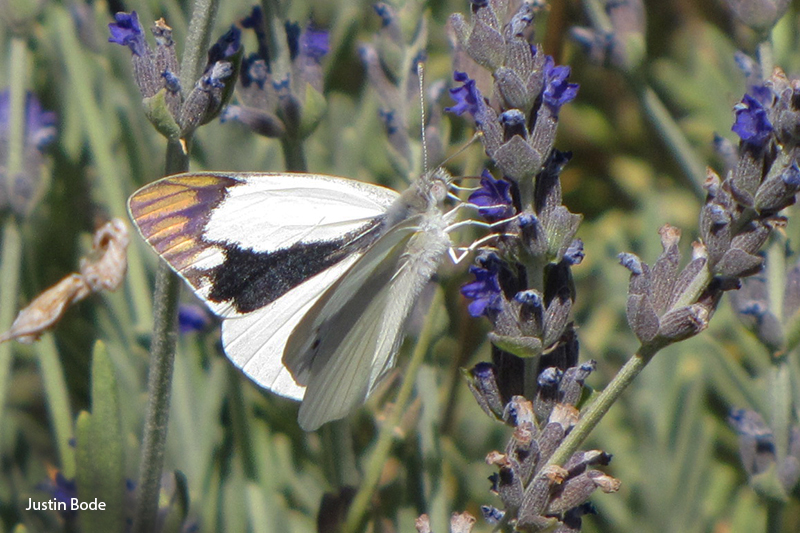
The dry-season form, fatma, has a pinkish hindwing and forewing-tip underside, as do many ‘Tips’. Males resemble eris but have narrower black markings. Females of form fatma have a brown forewing tip (arrowed) with yellow cells.

Form abyssinicus is a female form with wings that are cream rather than white.

Banded Gold Tip ♂

Teracolus eris eris form damara

Banded Gold Tip ♂

Teracolus eris eris form damara
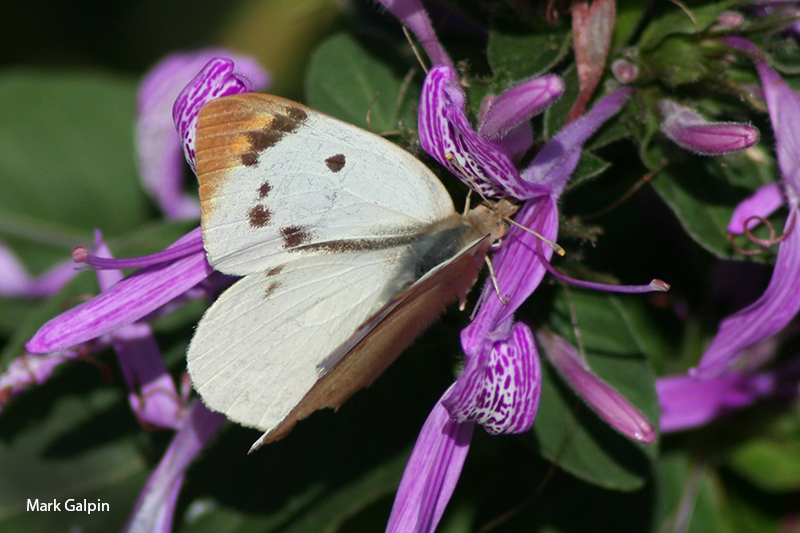
Banded Gold Tip ♀

Teracolus eris eris form johnstoni
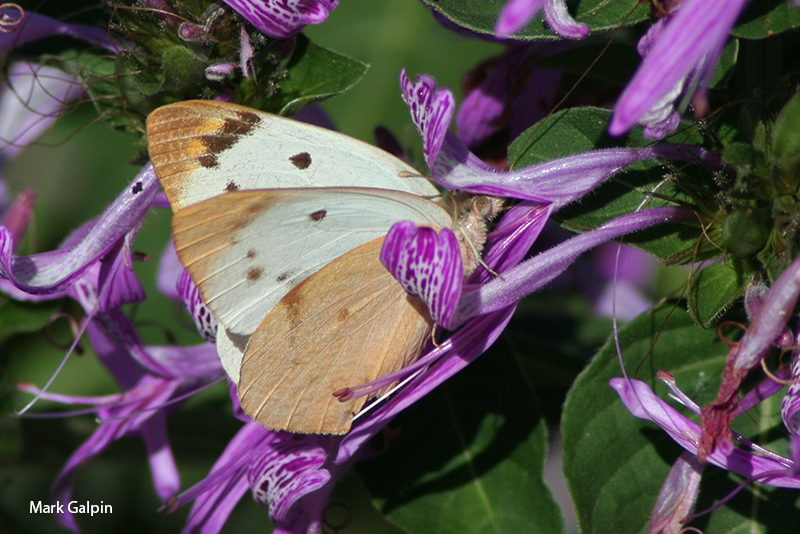
Banded Gold Tip ♀

Teracolus eris eris form johnstoni
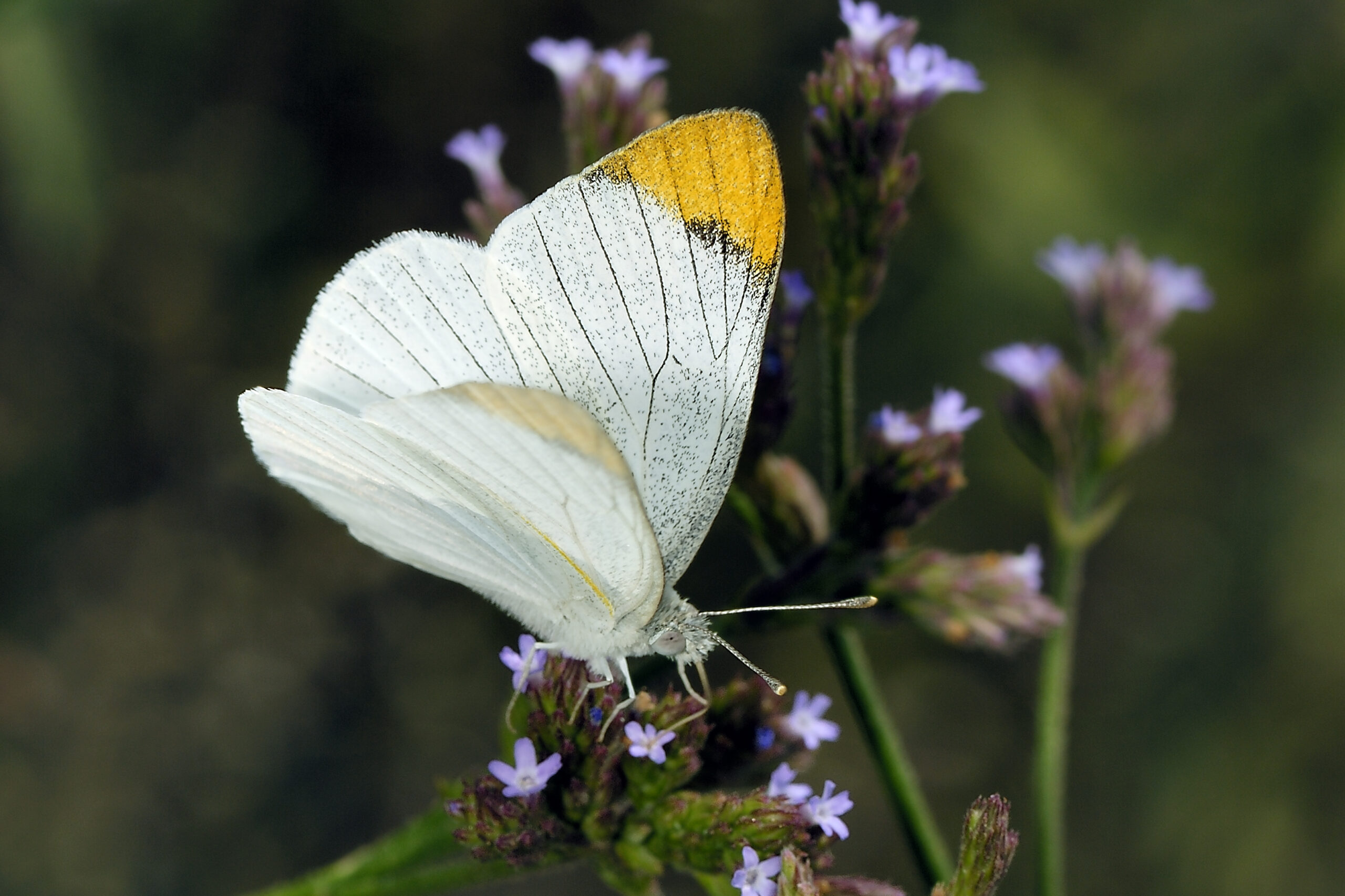
The desert form, damara, has restricted black markings on the upper side and a plain white hindwing underside, as in form eris.

Form johnstoni, found in the arid Albany Thicket of the Eastern Cape, has a female form with pale brown forewing tips that lacks the broad band along the inner forewing margin. Its hindwing underside is brown, unlike the pink of the similar form fatma.

Speckled Sulphur Tip ♂

Teracolus agoye agoye wet season form
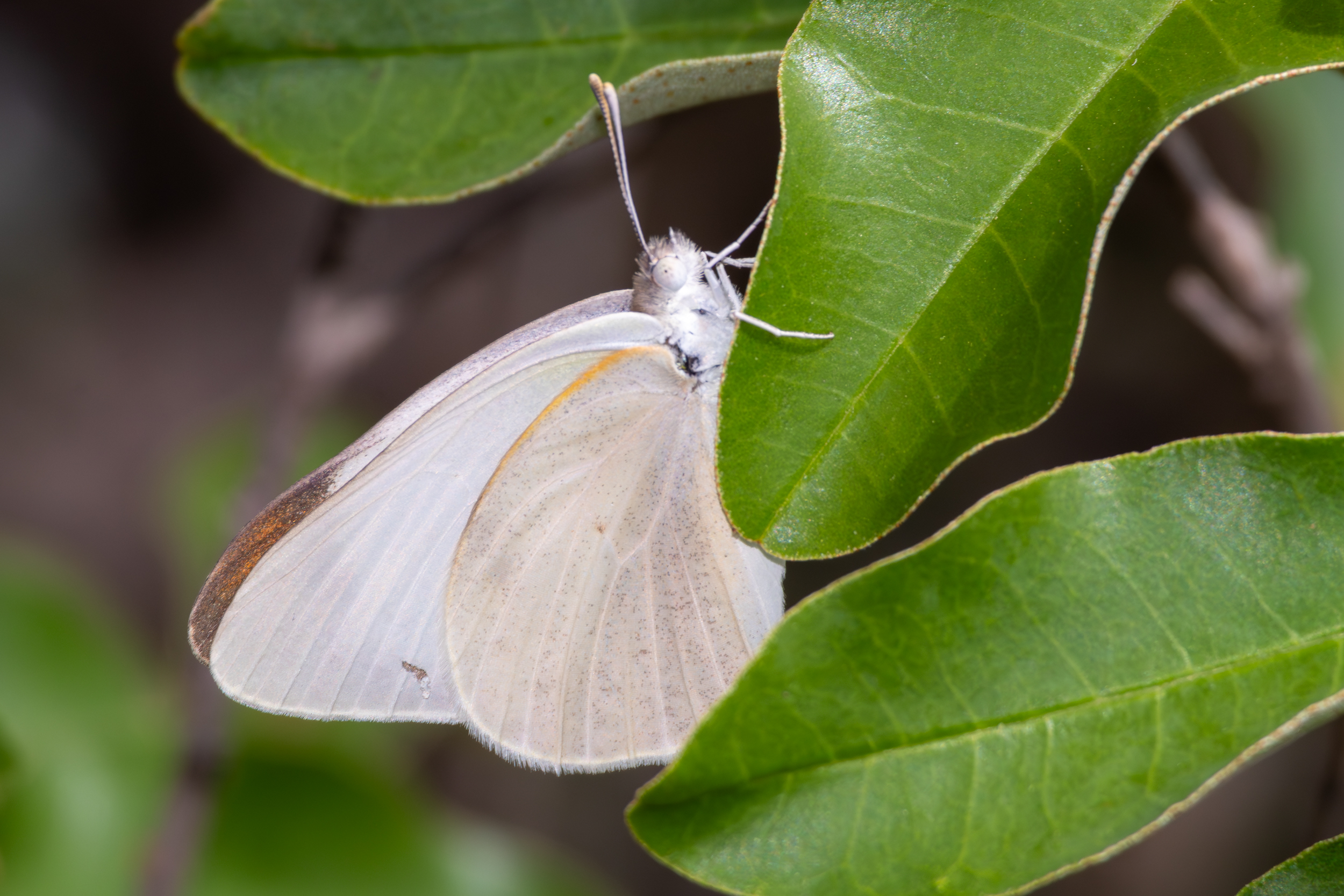
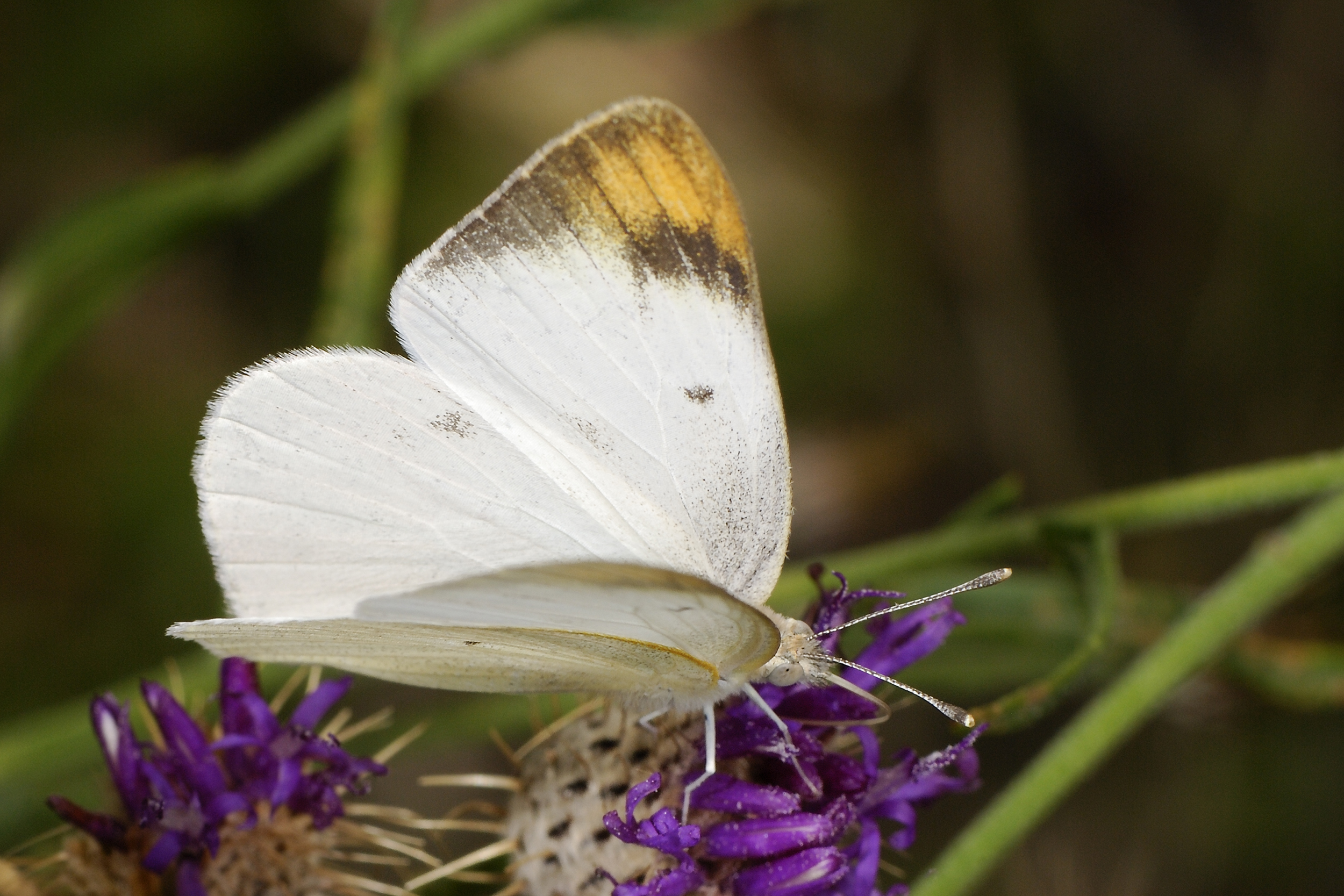
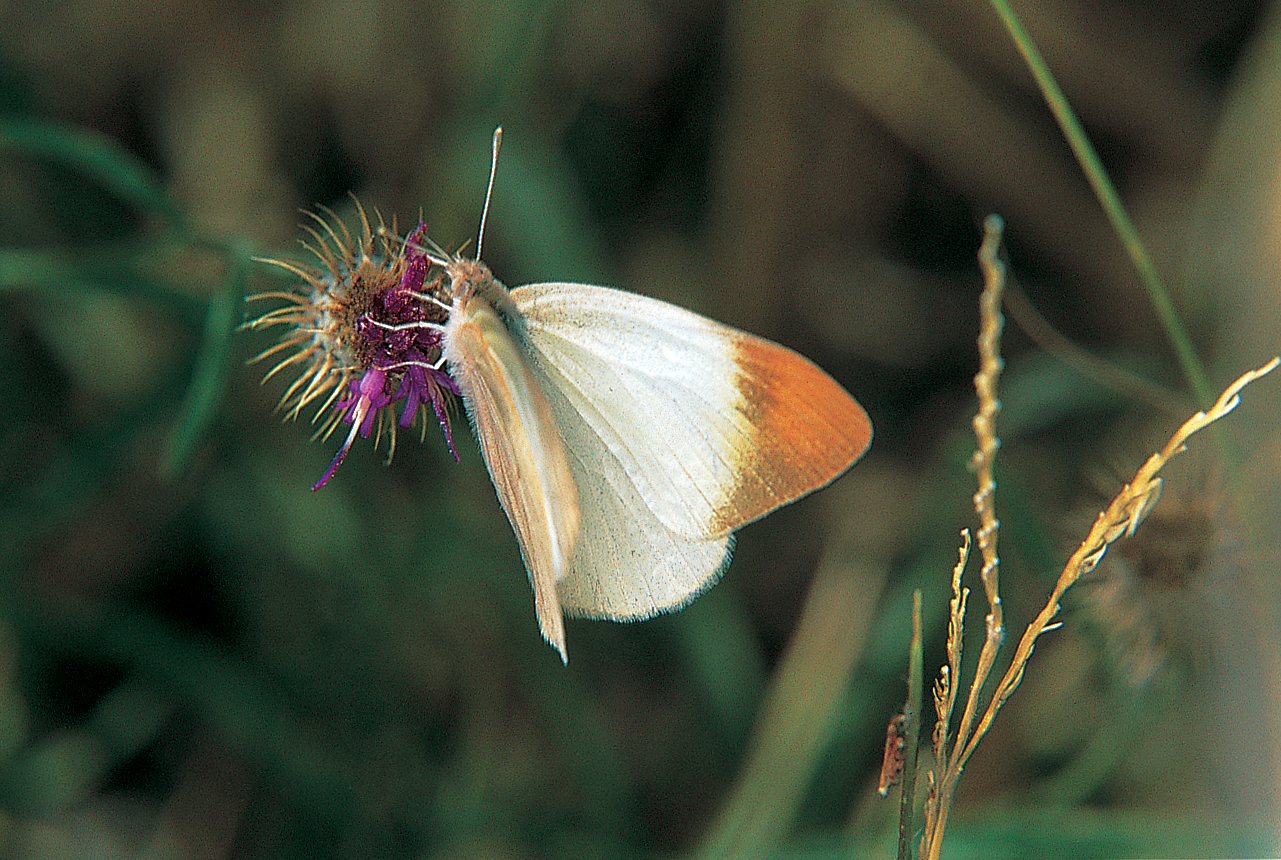
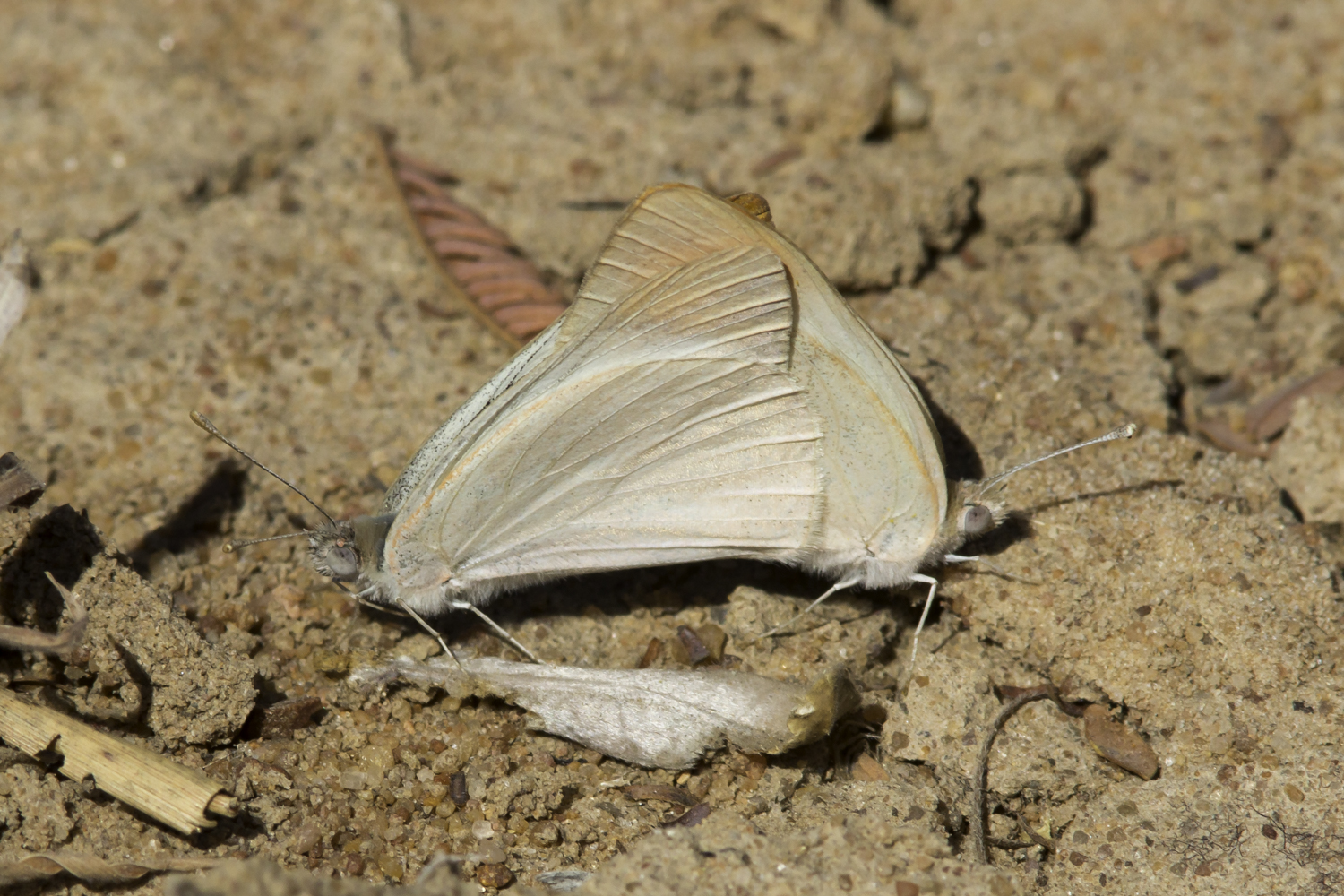
The Speckled Sulphur Tip, Teracolus agoye, is the smallest of the genus. Males are 30–40mm across, females 32–45mm. The forewings are elongated and pointed especially in the male. Males of the nominate subspecies Teracolus agoye agoye have blue iridescence over the yellow forewing tip; the females’ tips are dull buff and grey-black. The underside hindwing has no stripes, spots or bands. Wet season males of the nominate subspecies have the white upper side areas covered with a dusting of black scales (hence ‘speckled’). Their undersides are plain white. Dry season individuals have fewer speckles, and their undersides are brownish white to buff. The females have redder forewing tips.

Speckled Sulphur Tip ♂

Teracolus agoye agoye wet season form
Speckled Sulphur Tip ♀

Teracolus agoye agoye wet season form
Speckled Sulphur Tip ♀

Teracolus agoye agoye dryseason form
Speckled Sulphur Tip ♀

Teracolus agoye agoye dry season form
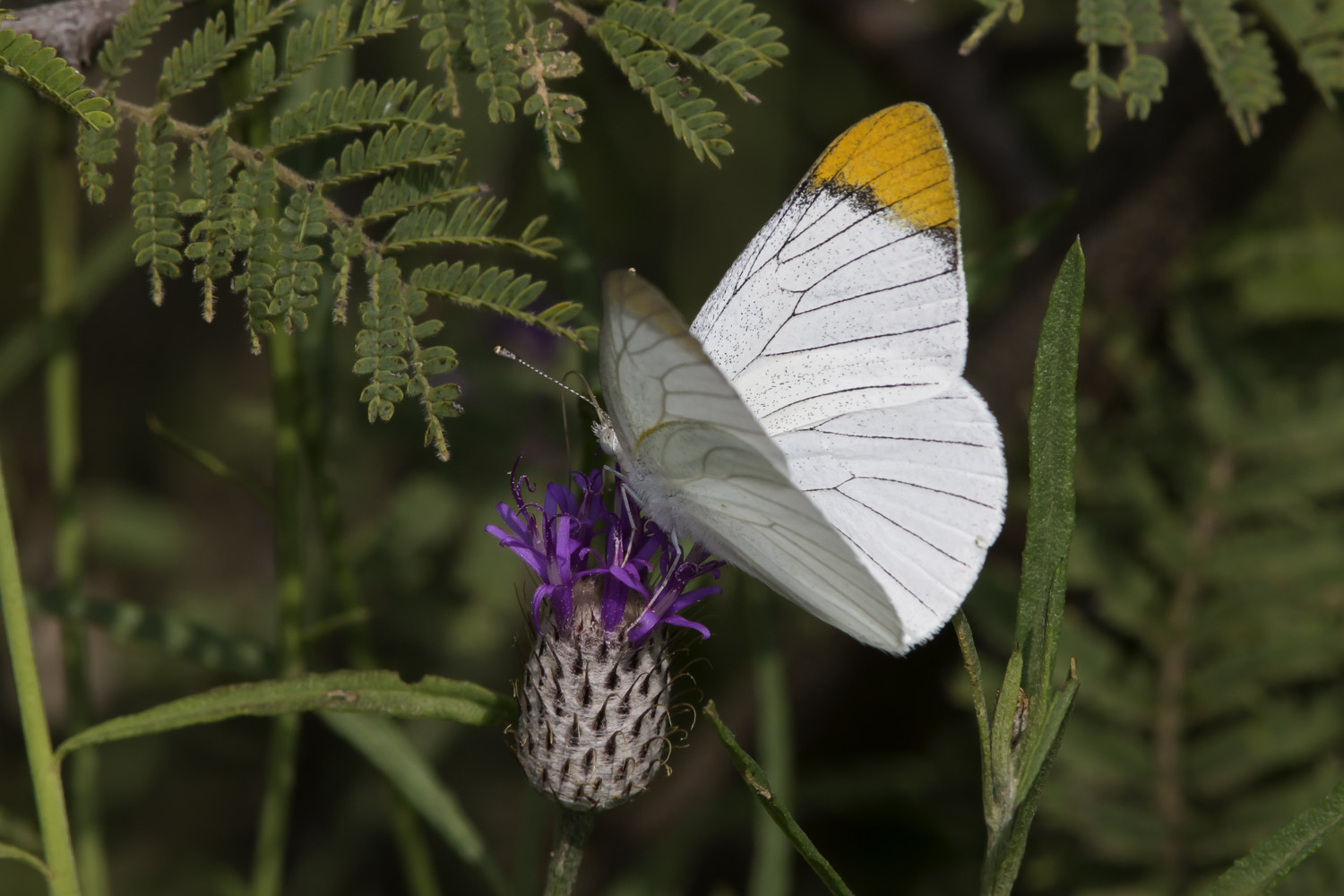
It is found in semi-arid savanna. Both sexes are fast flying, attracted to flowers and may rest on the ground. The caterpillars feed on Shepherd’s-tree Boscia albitrunca and Worm Bushes Cadaba species.

The Desert Speckled Sulphur Tip, Teracolus agoye bowkeri, is confined to the arid Nama Karoo and is smaller with a more pronounced black basal edge (arrowed) to the forewing tip. It tends to fly more slowly and lower down than the nominate subspecies.

Speckled Sulphur Tip ♂

Teracolus agoye agoye dry season form
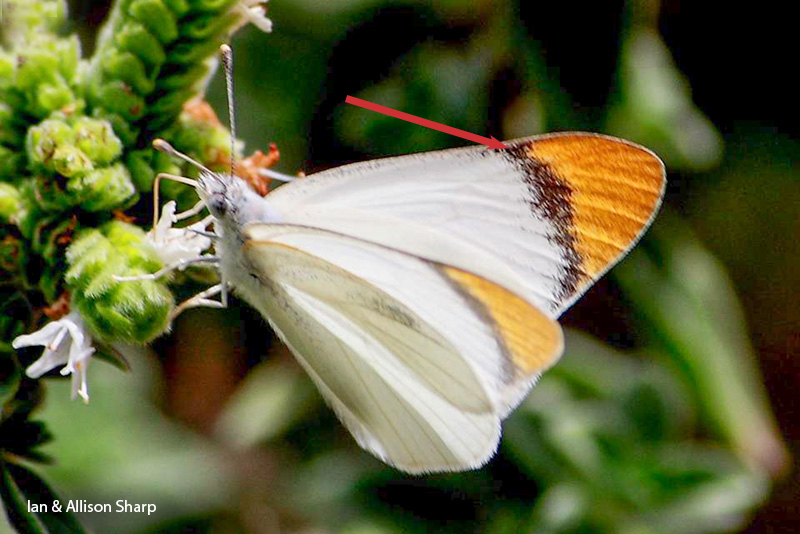
Desert Speckled Sulphur Tip ♂

Teracolus agoye bowkeri

Confused? Don’t be! These butterflies can be difficult to separate but if you learn the clues and apply them, they can be decoded. They are nowhere near as bad as some of the Blues and Opals in the Lycaenidae, where you may need a dissecting microscope or a DNA sequencer to untangle them!

This concludes Part Two of the Tips, concentrating on the species that don’t have orange tips in both sexes. Some other Colotis species don’t have coloured wingtips at all, and have patterns of pink and white on a black background. They are referred to as Arabs, not Tips. These are shown below.

Veined Arab ♂

Colotis vesta argillaceus wet season form pluvius
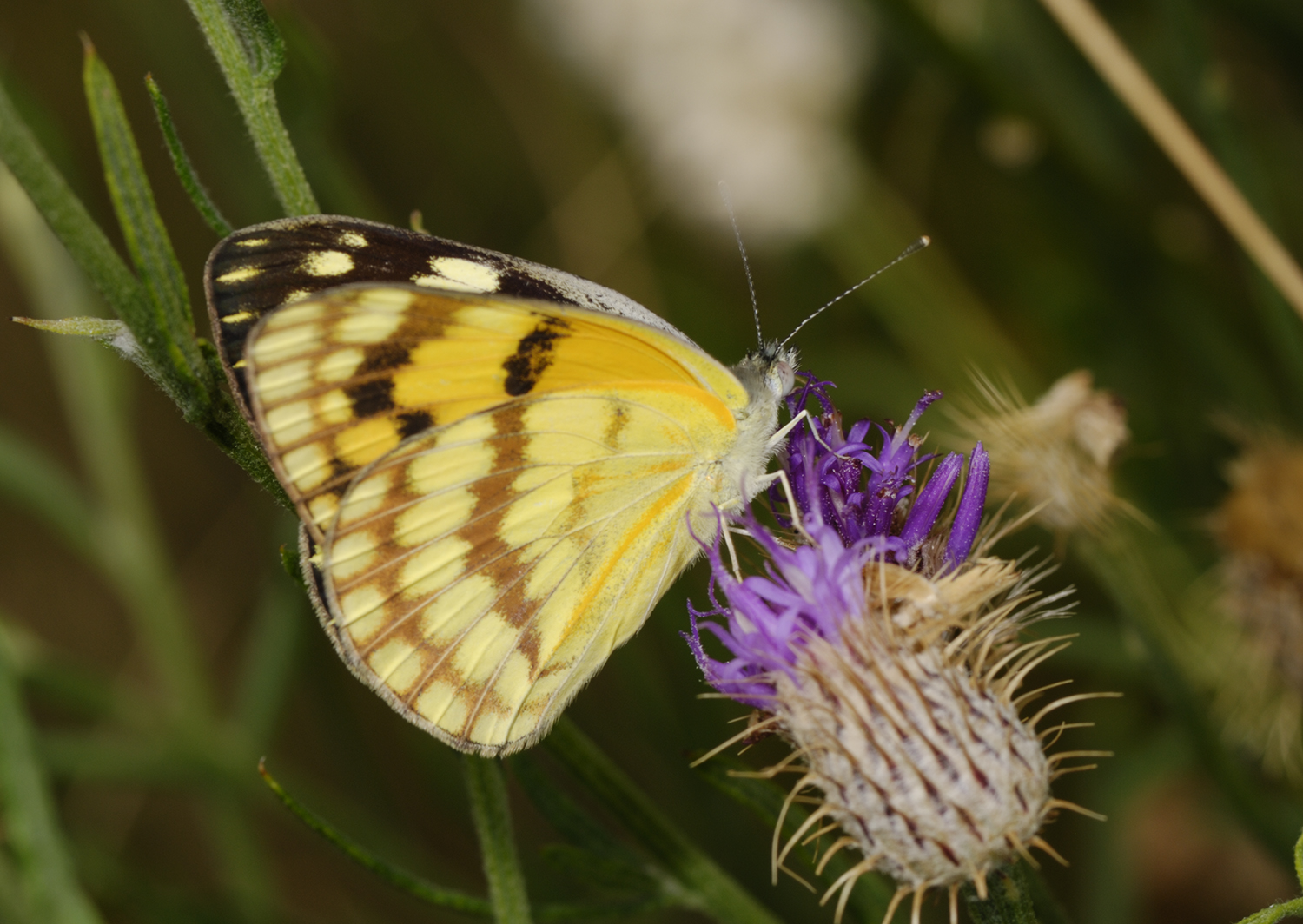
Veined Arab ♂

Colotis vesta argillaceus wet season form pluvius

Veined Arab ♀

Colotis vesta argillaceus wet season form pluvius
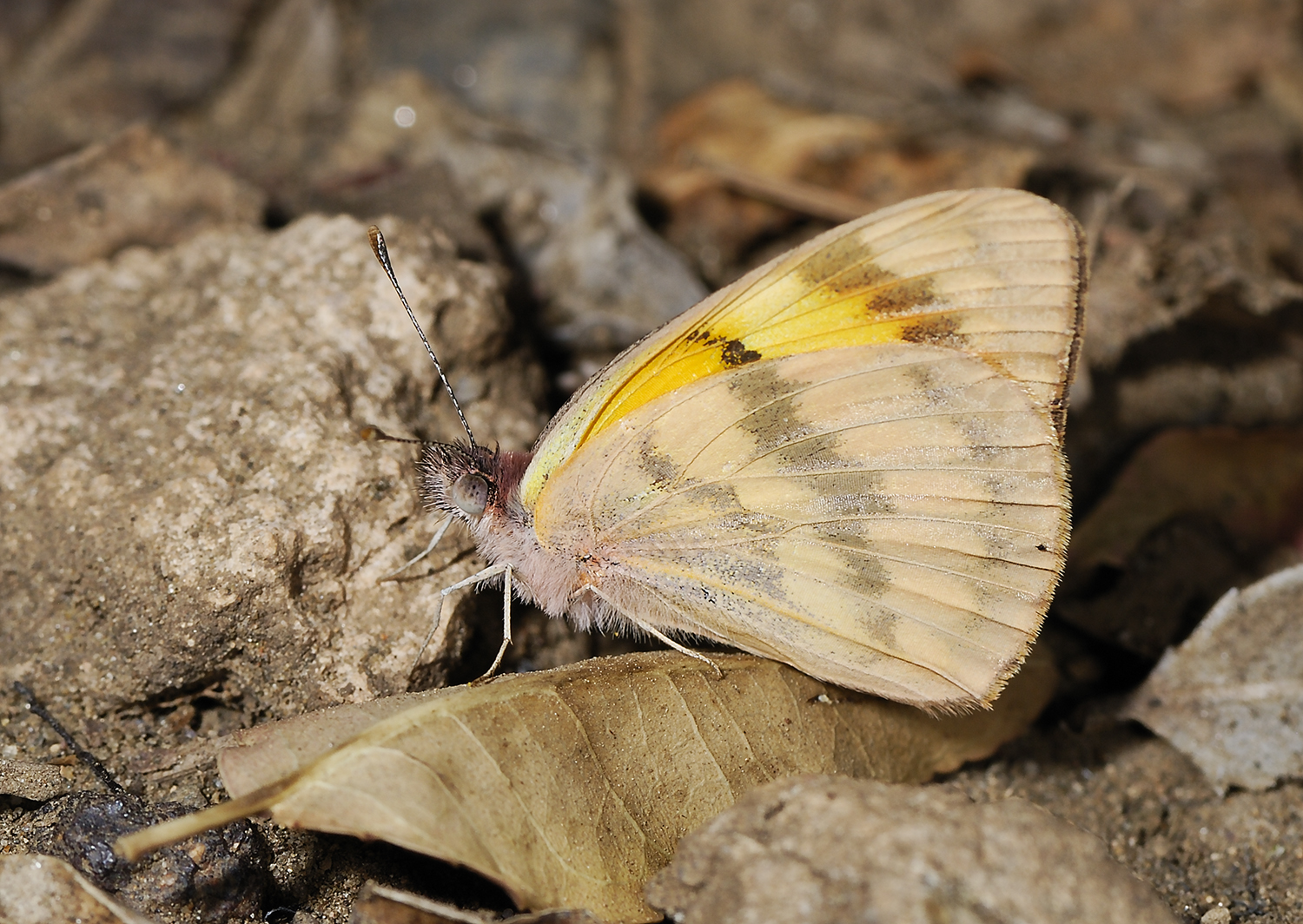
Veined Arab ♂

Colotis vesta argillaceus dry season form argillaceus
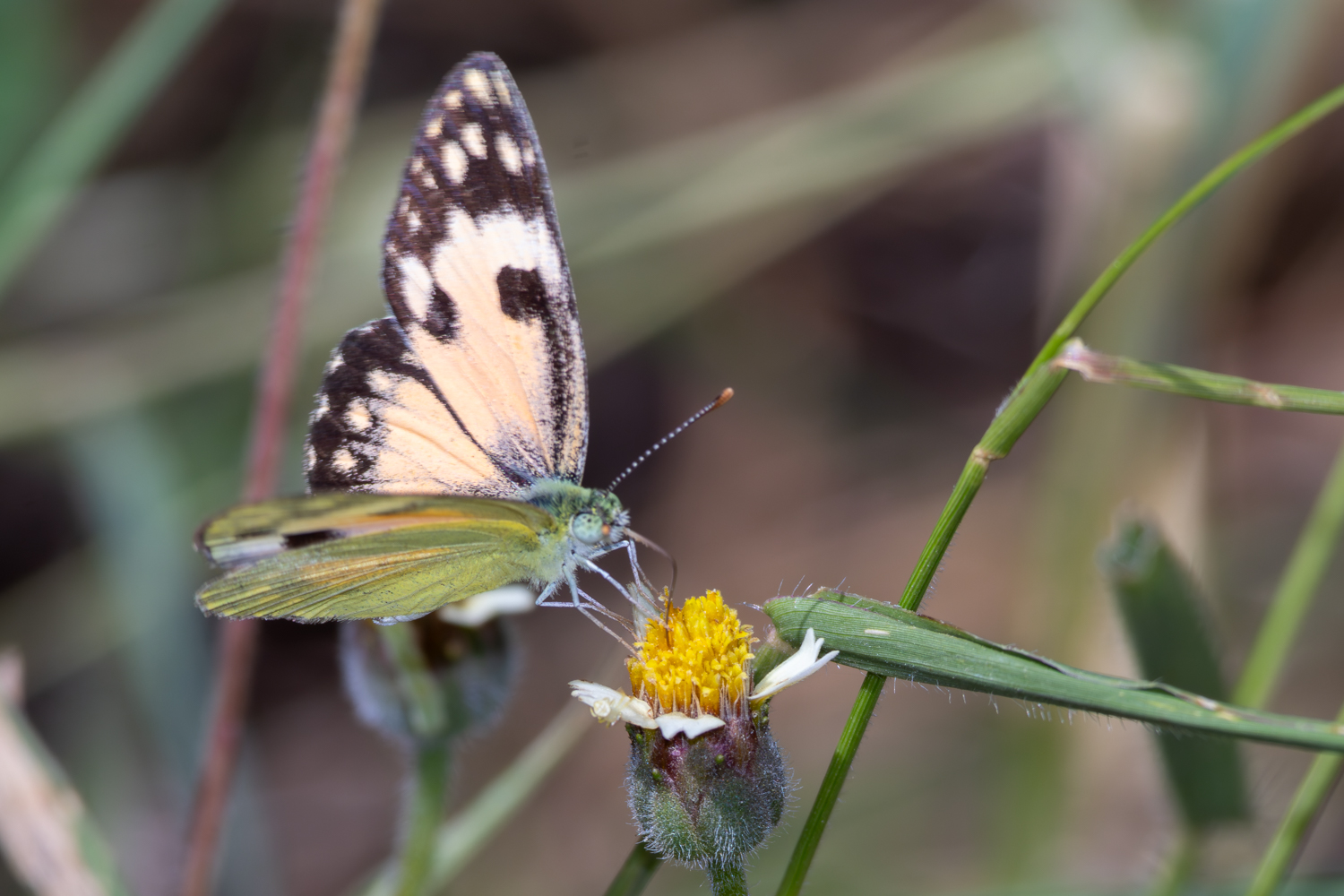
The Veined Arab Colotis vesta argillaceus is a colourful small (wingspan 32-45mm) butterfly with wet and dry season forms. The males and females have quite different appearances as shown here. It’s a slow-flying butterfly that is usually easy to approach. Its caterpillars feed on the same plants as the other ‘tips’, also on Mustard-tree Salvadora persica. It has several subspecies and is found all over sub-Saharan Africa in mesic to arid savanna.

Topaz Arab ♂

Colotis calais

Topaz Arab ♂

Colotis calais
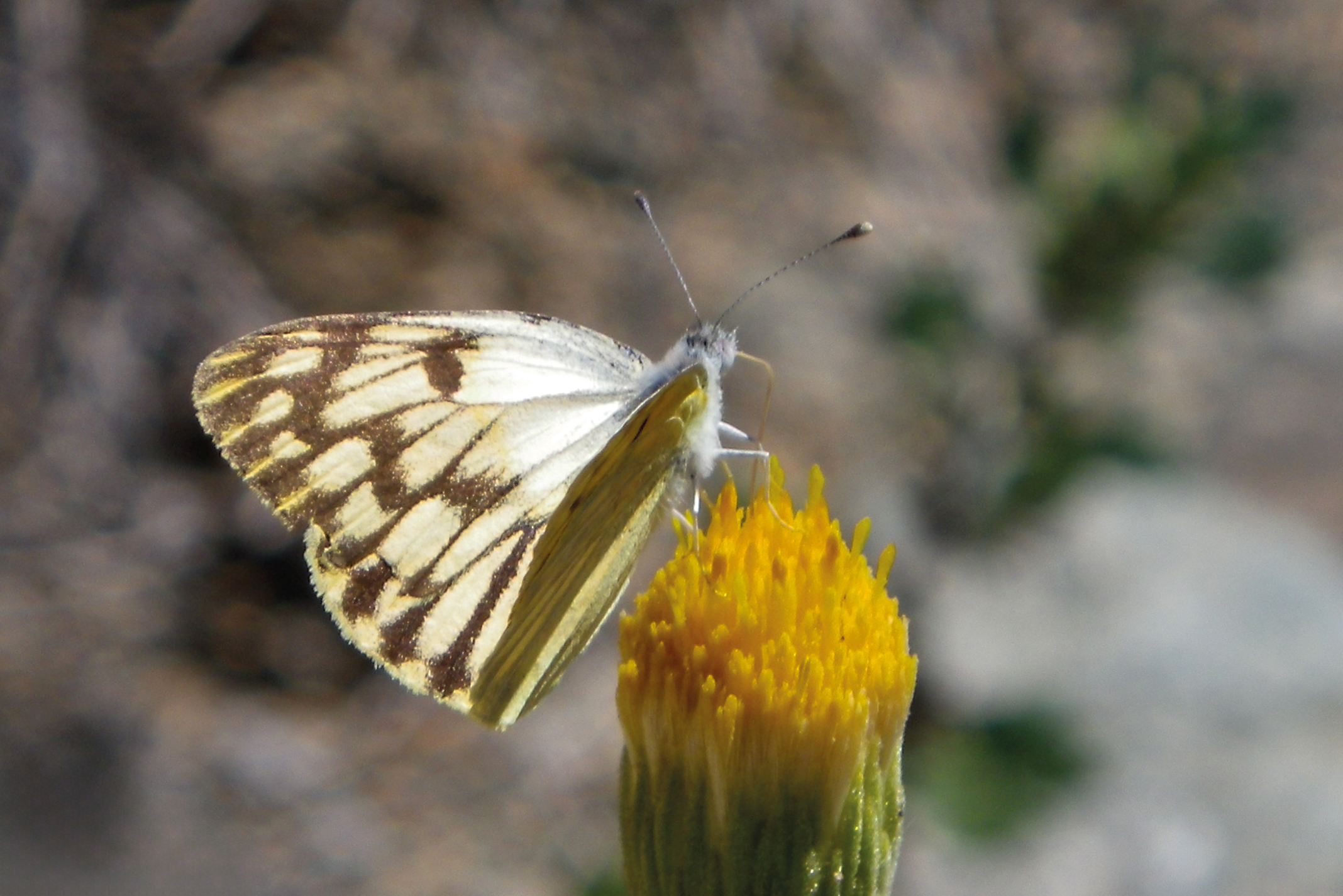
The Topaz Arab Colotis calais calais is another colourful small species (wingspan 32-38mm). Like Colotis calais it is slow flying. Its caterpillars feed on Mustard-tree Salvadora persica. It is found all over sub-Saharan Africa in arid, frost-free savanna.

Desert Arab ♂

Colotis doubledayi © Anthony Walton
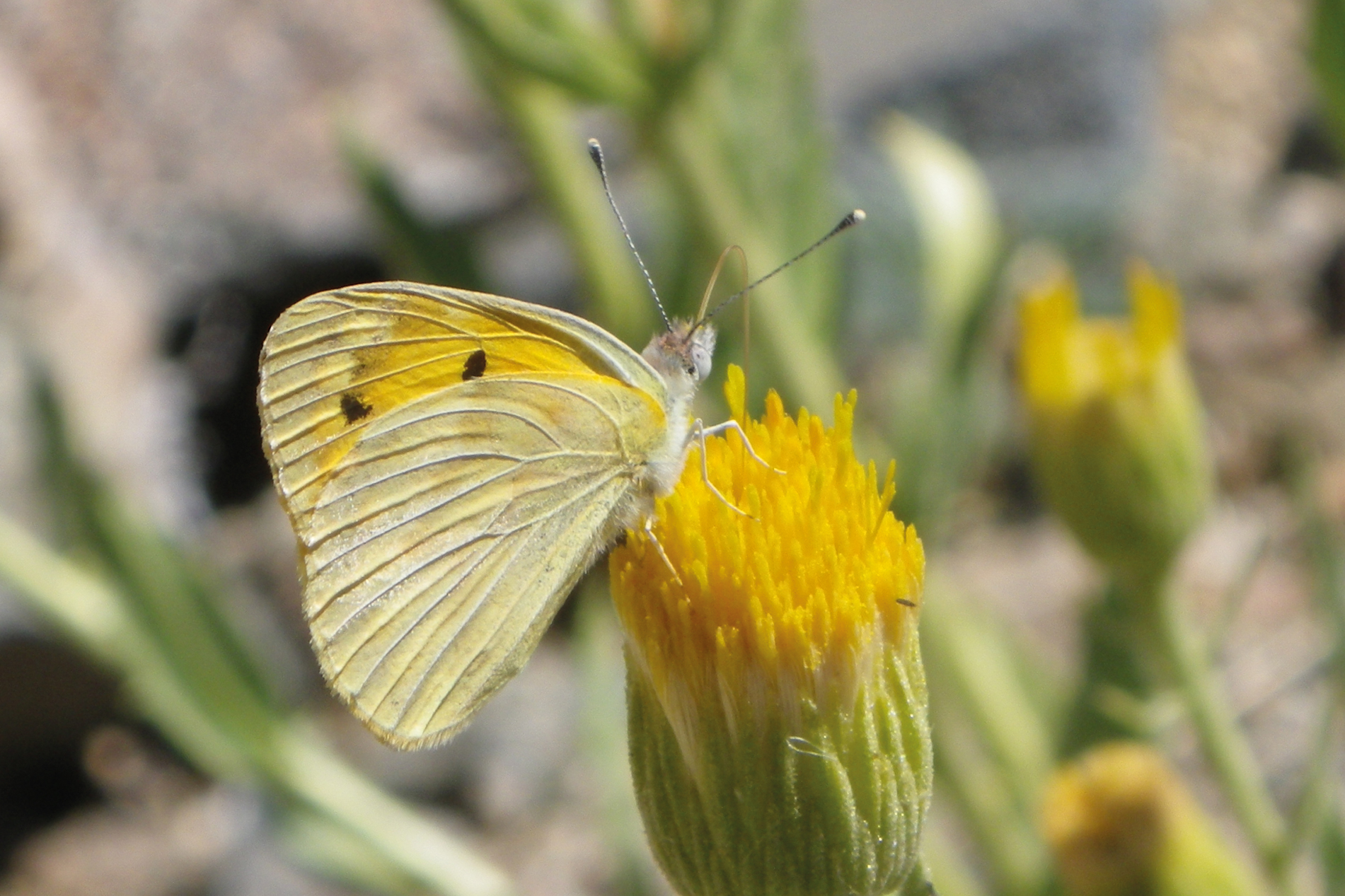
Desert Arab ♂

Colotis doubledayi © Anthony Walton

The Desert Arab Colotis doubledayi is a rare desert species that occurs mostly in the coastal areas of Angola and Namibia and only enters South Africa along the Gariep River where it borders Namibia. Its caterpillars feed on Ringwood Bead-bean Maerua schinzii which grows in arid gullies feeding into the Gariep.

If you’ve enjoyed this please drop me a message at steve@butterflygear.co.za to say so, and if there is anything I can improve upon, please let me know.